Organism · Montsechia
Montsechia vidalii
Source time context (not species duration) · ≈ 130–125 Ma
Inferred life reconstruction
Montsechia vidalii
Overview
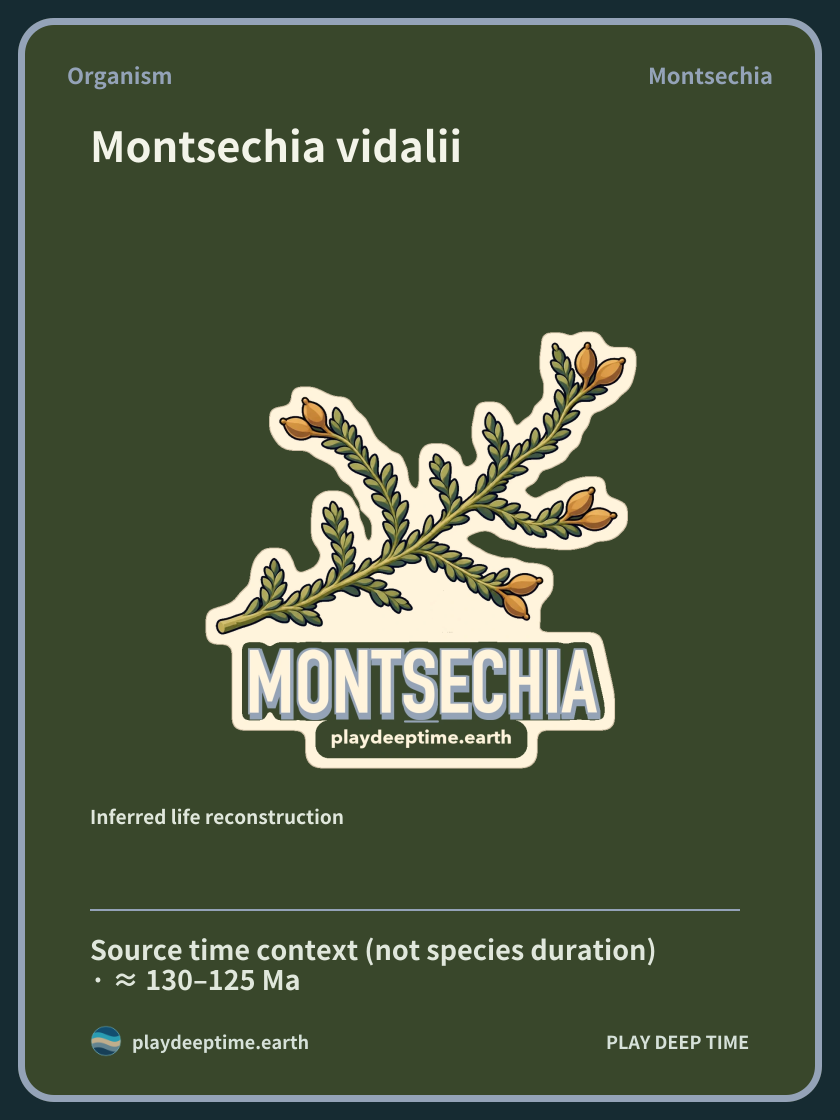
Montsechia vidalii was an underwater angiosperm of the Early Cretaceous. Slender branches, small leaves, and seed-enclosing fruits are known. It invites exploration of early flowering plant history alongside aquatic life.[1]
Loading illustration…
Key facts
Researchers examined more than a thousand stems but found no roots. Flexible branches and a very thin cuticle provided clues to aquatic life. Its combination of structures differs intriguingly from familiar terrestrial flowering plants.[1]
Time and place
It is known from freshwater layers of the Barremian, Early Cretaceous, about 130–125 million years ago. Fossils came from limestone in the Pyrenees and Iberian Range of present-day Spain. They provide evidence for investigating the underwater environment inhabited by early angiosperms.[1]
The time range describes source context, not the complete duration of this species.
Size, form and skeleton
Researchers studied one form with opposite branches and long, slender leaves and another with spirally arranged branches and short, scale-like leaves. Small fruits commonly occur in pairs at branch tips. Each fruit is described as containing one inverted, hanging seed.[1]
A small Montsechia vidalii branch offers a close look at a Cretaceous plant. Specimen CM 145 from Cusano Mutri in present-day Italy preserves a branch portion 2.1 cm long and about 1.2 cm wide. Leaves attached along the stem were 1.5 mm or less, much smaller than the branch.[9]
Loading illustration…
Habitat and reproduction
It is an aquatic plant known from freshwater limestone fossils. In 2015, researchers proposed that it lived underwater and was pollinated through water, based on reproductive structures and habitat context. Tiny fruits at branch tips tell a story of ancient underwater reproduction.[1]
Fossil discovery
A 2015 study compared numerous stems and fruits and treated Montsechia as an ancient aquatic angiosperm. It compared the microstructure and female organs of two leaf forms occurring together in the same layers. Close examination of tiny fruits led into a larger story of plant evolution.[1]
References
- Gomez et al. (2015) — Montsechia, an ancient aquatic angiosperm
- Gomez et al. (2015) — Montsechia, an ancient aquatic angiosperm
- Pluricarpellatia, a nymphaealean angiosperm from the Lower Cretaceous of northern Gondwana (Crato Formation, Brazil)
- Gomez et al. (2015) — Montsechia, an ancient aquatic angiosperm
- Webb et al. (1988) — Species description of Ceratophyllum demersum
- Flora of New Zealand — Ceratophyllaceae
- Kew — Present-day distribution of Ceratophyllum demersum
- Flora of New Zealand — Ceratophyllum
- Bartiromo (2012) — A thesis on Cretaceous plants
Research questions
How were the two leaf and branching forms related? Researchers proposed that they may have belonged to the same species because their microstructure and female organs matched. The case raises questions about early angiosperm bodies and living spaces.[1]
Observation
Follow the slender branches to examine leaf arrangement. Finally, imagine the small fruits at branch tips and the seeds inside them to see the aquatic plant’s body and reproductive structures together.[1]
Related organisms
 Pluricarpellatia peltataFlowering plantsSource time context (not species duration) · ≈ 143–66 Ma
Different forms of Early Cretaceous flowering plants
Montsechia from present-day Spain and Pluricarpellatia from Brazil’s Crato Formation show different Early Cretaceous angiosperm forms. Montsechia reveals slender branches and small fruits; Pluricarpellatia reveals broad leaves, roots, and reproductive structures preserving seeds. Compare early flowering plants through several organs.
 Ceratophyllum demersumFlowering plantsPresent
An ancient aquatic plant and today’s rigid hornwort
Montsechia researchers examined many fossil stems but found no roots. Living rigid hornwort grows underwater without roots. Comparing stems and leaves of two plants from different times invites consideration of possible body arrangements for aquatic plants.