Organism · Placental mammals
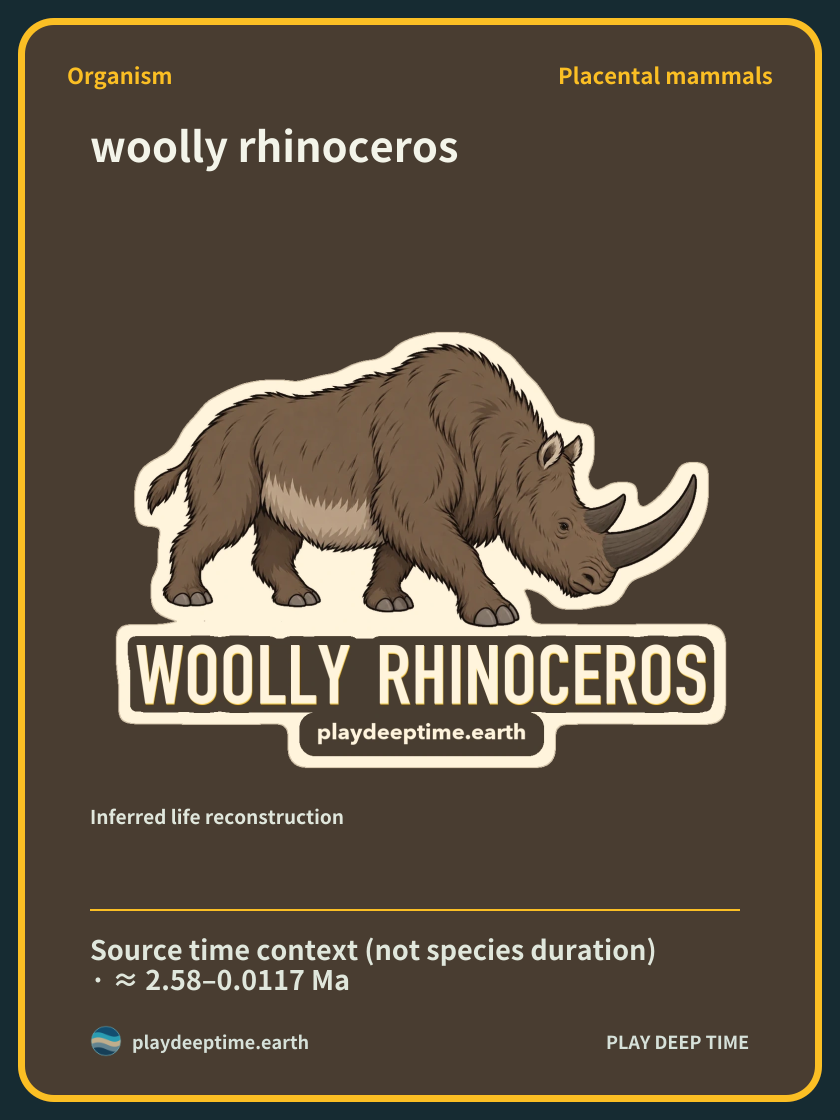
woolly rhinoceros
Source time context (not species duration) · ≈ 2.58–0.0117 Ma
Inferred life reconstruction
Coelodonta antiquitatis
Overview
The woolly rhinoceros is a large Ice Age herbivore with thick fur and two horns. Its low-held head and molars for processing tough grasses stand out. Bones and even frozen bodies reveal its ancient appearance.[1][2]
Loading illustration…
Key facts
The main material of its large horns is keratin, not bone. The same substance occurs in human hair and nails. Frozen fossils preserving horns and skin together reveal features difficult to see from bones alone.[1][2]
Time and place
This animal is associated with Eurasian landscapes of the Pleistocene Ice Age, hundreds of thousands to tens of thousands of years ago. Material from open European grasslands and frozen specimens from present-day Yakutia, Russia, are known. Fossils from distant regions reveal its ancient distribution.[1][3]
The time range describes source context, not the complete duration of this species.
Size, form and skeleton
A substantial body lay beneath thick fur, with two horns on the nose. A low-held head and high-crowned molars are characteristic. Museum educational material presents it as a large animal approximately 2 m tall.[1]
Loading illustration…
Habitat and reproduction
It is studied as a herbivore living in open grasslands. High-crowned molars are linked to chewing tough grasses. Considering fur and food-processing teeth together gives a fuller picture of Ice Age life.[1]
Fossil discovery
A 2011 study presented a nearly complete frozen body from the lower Kolyma River. The head and ears, skin from front and rear legs, and a skull with two horns were known. In 2024, the fur and back region of a young frozen specimen were also studied, adding a growth story.[2][3]
References
- Educational material on a woolly rhinoceros fossil jaw
- Boeskorov et al.2011 — Frozen woolly rhinoceros fossils from the Kolyma River
- Boeskorov et al.2024 — A frozen juvenile woolly rhinoceros specimen
- Bai, B., J. Meng, Y.-Q. Wang, H.-B. Wang, and L. Holbrook (2017). “Osteology of the Middle Eocene ceratomorph Hyrachyus modestus (Mammalia, Perissodactyla).” Bulletin of the American Museum of Natural History, no. 413.
- Reading Museum — Woolly rhinoceros fossil jaw
Research questions
How did young woolly rhinos change as they grew? Researchers compare the body, fur, and back of a juvenile with larger individuals. Studying frozen bodies alongside fossil bones connects growth with Ice Age adaptations.[3][2]
Observation
Move your gaze from the two horns to the low head and jaws, then to the fur covering the body. Picture grass-chewing teeth alongside a body living in a cold environment.[1]
Related organisms
 Hyrachyus modestusPlacental mammalsSource time context (not species duration) · ≈ 56–33.9 Ma
Odd-toed ungulates from widely separated times
Eocene Hyrachyus and the Ice Age woolly rhinoceros are odd-toed ungulates from widely separated times. Compare their heads, legs, and feet to explore the varied bodies within the broad family tree that includes tapir and rhino relatives.