Organism · Placental mammals
Hyrachyus modestus
Source time context (not species duration) · ≈ 56–33.9 Ma
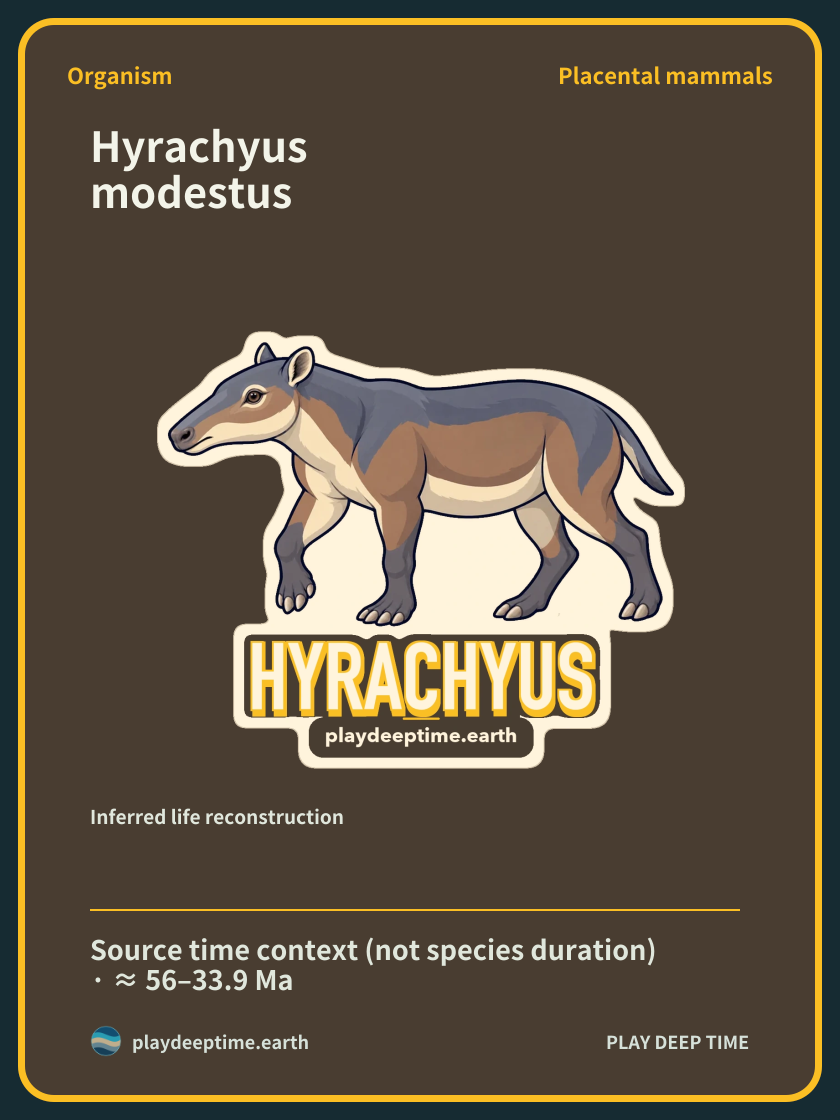
Inferred life reconstruction
Hyrachyus modestus
Overview
Hyrachyus modestus is an ancient odd-toed ungulate from the Eocene. It reveals the early diversity of relatives that bring rhinos and tapirs to mind. Its story centers on a long face, toes, and legs suited to running rather than enormous horns.[1]
Loading illustration…
Key facts
Four functional toes on the forefeet and three on the hind feet have been studied. Compared with the single hoof of a modern horse, they reveal the variety of feet among odd-toed ungulates. Toe numbers and limb proportions are linked to differences in movement.[1]
Time and place
It lived in North America during the middle Eocene, roughly 40–50 million years ago. Important specimens came from the Bridger Basin in present-day Wyoming, USA. Bones from several localities, including Grizzly Buttes and Henrys Fork, were compared.[1]
The time range describes source context, not the complete duration of this species.
Size, form and skeleton
The face is longer than the braincase at the back of the skull, and the eye sockets are relatively large and round. The upper outline of the skull is broadly horizontal. Trunk and limb material allows researchers to examine head shape alongside leg function.[1]
Loading illustration…
Habitat and reproduction
A 2017 skeletal study interpreted adaptations suited to running. This interpretation came from comparisons of forearm-to-upper-arm length proportions and hand and foot structures with other early odd-toed ungulates. It invites us to consider which combinations of bones form a body that moves over land.[1]
Fossil discovery
The principal specimen, AMNH FM12664, was collected in the Bridger Basin in 1905. A 2017 study described this skeleton and several supplementary specimens in detail. Old museum material can still address questions about body evolution a century later.[1]
References
Research questions
What kinds of bodies existed as tapir and rhino relatives were diverging? Comparing Hyrachyus with other early odd-toed ungulates reveals changes in the head, feet, and legs. These fossils show ancient diversity among the relatives of familiar animals today.[1]
Observation
Move your gaze from the long face to the trunk and toes.[1]
Related organisms
 woolly rhinocerosPlacental mammalsSource time context (not species duration) · ≈ 2.58–0.0117 Ma
Odd-toed ungulates from widely separated times
Eocene Hyrachyus and the Ice Age woolly rhinoceros are odd-toed ungulates from widely separated times. Compare their heads, legs, and feet to explore the varied bodies within the broad family tree that includes tapir and rhino relatives.