Organism · Cnidarians
Conularia niagarensis
Fossil record age bounds · ≈ 443–423 Ma
Inferred life reconstruction
Conularia niagarensis
Overview
Conularia niagarensis is a fossil with closely spaced transverse ridges and small nodes preserved on a hard outer covering. Follow the chevron-like patterns to explore the construction of this small surface.[1]
Loading illustration…
Key facts
Rounded nodes on the transverse ridges and small ridges between them are slightly offset from neighboring rows. What looks like simple striping reveals a staggered arrangement under magnification.[1]
Time and place
The specimens discussed in a 2022 research manuscript came from the Brandon Bridge Formation at Waukesha in present-day Wisconsin, USA. The locality is described as late Telychian, in the early Silurian.[1]
The time range describes source context, not the complete duration of this species.
Size, form and skeleton
The transverse ridges are thin and closely spaced, crossing the shell face without interruption. Rounded nodes line the ridges, and small rod-like ridges cross the spaces between them.[1]
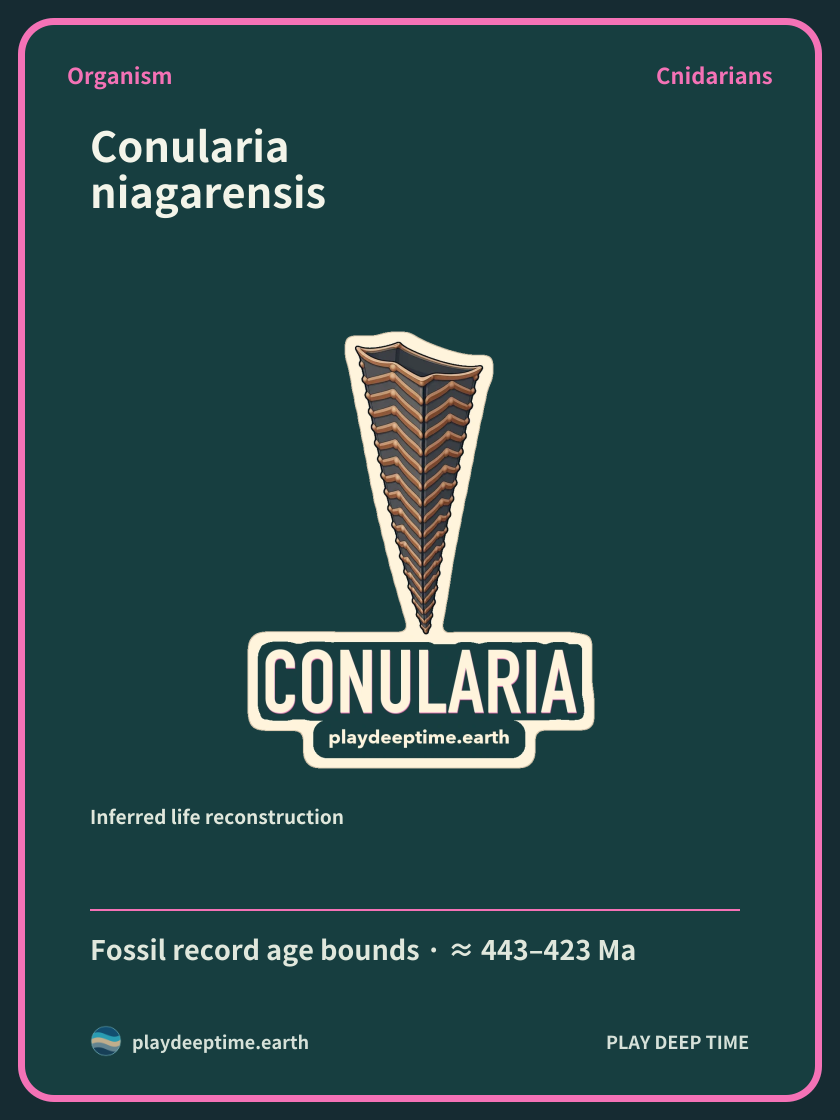
Conularia niagarensis formed a four-sided, cone-like outer covering in Silurian seas. A paper studying fossils from Waukesha in present-day Wisconsin, USA, reported specimen lengths from 6 mm to 4 cm. Closely spaced transverse lines and small projections remain on the covering, revealing regular patterns even in tiny fossils.[2]
Loading illustration…
Habitat and reproduction
Waukesha is a fossil locality preserving diverse Silurian organisms together. The research manuscript examined conulariid preservation there and interpreted processes of compression and mineral alteration after burial.[1]
Fossil discovery
The later-selected name-bearing specimen of the species described by Hall in 1852 is AMNH31625 from New York. The research manuscript distinguished this reference material from the Waukesha study specimens when comparing them.[1]
References
- Miller et al. (2022, manuscript) — Surface patterns of Conularia from Waukesha
- Miller et al. (2022) — Silurian conulariids from Waukesha
- Miller et al. (2022) — Silurian conulariids from Waukesha
- Kues·Lucas (2001) — Cretaceous coastal fauna of the Tucumcari Formation
- Paleobiology Database — Coelosmilia texana
- Brahmi et al. (2010) — Skeletons and living tissues of stony corals
- International Commission on Stratigraphy (2024) — Geological time chart
Research questions
The researchers used light microscopy, electron microscopy, and compositional analysis together. The material making up the fossils, as well as the shapes of tiny patterns, provided clues for reading traces of ancient organisms.[1]
Observation
The image shows an interpretive restoration of the entire four-sided pyramidal theca rather than a surface fragment. Follow the outline from the broad aperture to the narrow end, then examine the transverse ribs and nodes. The end, depth and life colour are inferred; tentacles, soft tissues and attachment organs are not added.[1][2]
Related organisms
 Coelosmilia texanaCnidariansSource time context (not species duration) · ≈ 143–66 Ma
Different hard skeletons preserved in ancient seas
Explore different records of bodies and time in these two organisms. Conularia niagarensis: a fossil with closely spaced transverse ridges and small nodes on a hard outer covering; follow the chevron-like patterns to examine the small surface. Specimens in a 2022 research manuscript came from the Brandon Bridge Formation at Waukesha in present-day Wisconsin, USA, described as a late Telychian locality of the early Silurian. Coelosmilia texana: a solitary coral with a narrow, slightly curved, conical skeleton and thin septa inside its upper cup. Literature treats the species as Albian material of the Early Cretaceous. The Cretaceous spans roughly 140–66 million years ago, and the Albian is the final stage of its early part.