Organism · Dinosaurs
Dilophosaurus wetherilli
Source time context (not species duration) · ≈ 201–143 Ma
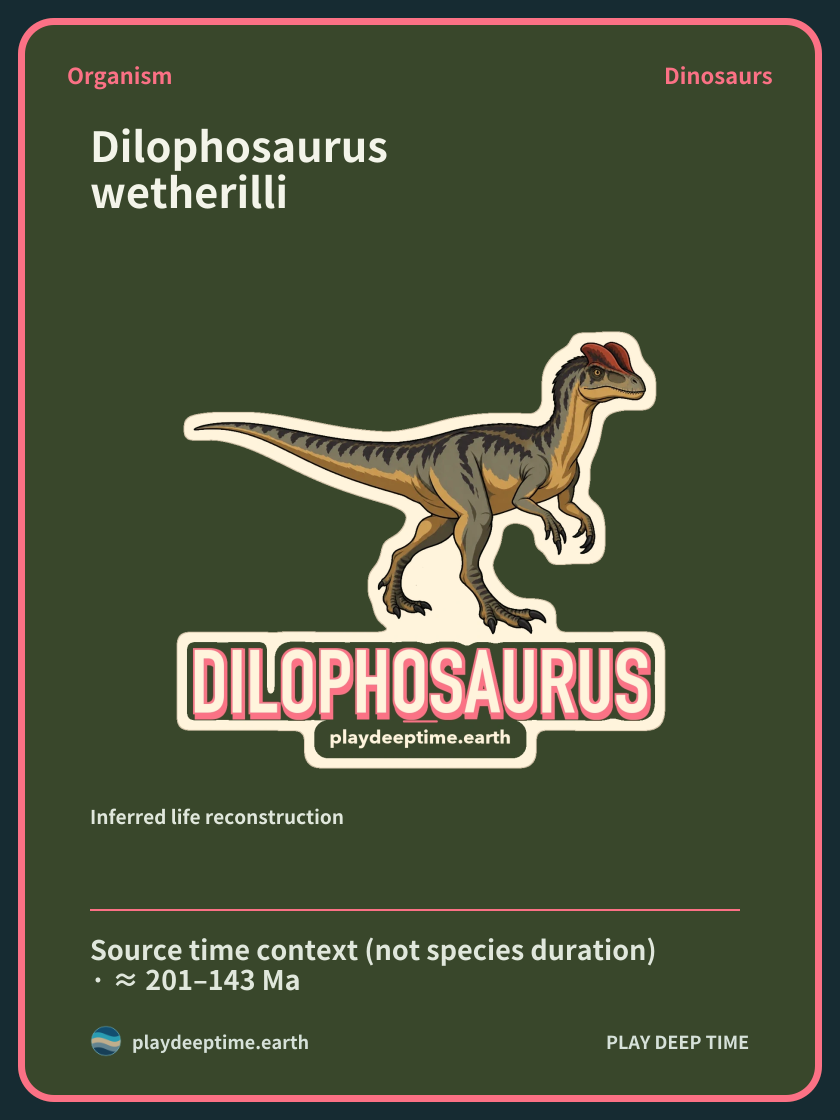
Inferred life reconstruction
Dilophosaurus wetherilli
Overview
Dilophosaurus wetherilli is a large carnivorous dinosaur with a pair of head crests. Nasal and lacrimal bones join to create its distinctive head outline. It is intriguing to compare a familiar movie animal with actual skeletal discoveries.[1][2]
Loading illustration…
Key facts
How different is its movie appearance from the body revealed by fossils? A 2020 university account introduced new research focused on strong jaws and paired crests. Comparing new specimens can reveal a different impression even of a famous dinosaur.[2]
Time and place
This dinosaur is known from the Early Jurassic Kayenta Formation. Fossils were collected in northern Arizona, USA, on land that is today part of the Navajo Nation. The Early Jurassic spans roughly 200–175 million years ago.[3][4]
The time range describes source context, not the complete duration of this species.
Size, form and skeleton
The two head crests are formed jointly by the nasal and lacrimal bones. The first three fingers are clawed, while the outer fourth finger is described as small and clawless. Large head ornaments can be compared alongside small differences within the hand.[1]
The Natural History Museum in London gives a body length of approximately 7 m in its account of the genus Dilophosaurus.[5]
Loading illustration…
Habitat and reproduction
It had the body of a carnivorous theropod with strong jaws. Food-processing jaws, three clawed fingers, and hind-limb construction can be examined together. Several specimens reveal the body of a large Early Jurassic predator.[1]
Fossil discovery
A comprehensive redescription in 2020 added new specimens to existing fossils and reassessed the body. Material from the Kayenta Formation in northern Arizona was compared. Even a familiar dinosaur name gains new bodily details through careful redescription.[1][3]
References
- Marsh & Rowe (2020) — Reassessment of the anatomy and relationships of Dilophosaurus
- University of Texas (2020) — New stories of a movie dinosaur and its fossils
- University of Texas Vertebrate Paleontology Collections — Dilophosaurus
- International Commission on Stratigraphy (2024) — Geological time chart
- Natural History Museum, London — Dilophosaurus
- Carnegie Museum — The Apatosaurus that went through two heads
- Gilmore1936 — The skeleton of Apatosaurus
Research questions
Which bones formed the paired head crests? Researchers compare skull connections and differences among specimens. Including details of hands and feet reveals the body beyond its striking crests.[1]
Observation
Picture the two crests separately, even though they may overlap in side view. Then compare the large clawed fingers with the small outer finger to reveal finer body details.[1]
Related organisms
 Apatosaurus louisaeDinosaursSource time context (not species duration) · ≈ 201–143 Ma
Different bodies among dinosaurs
Explore the bodies and backgrounds of Dilophosaurus and Apatosaurus together. Dilophosaurus: Dilophosaurus wetherilli is a large carnivorous dinosaur with paired head crests formed by the nasal and lacrimal bones. Apatosaurus: Apatosaurus louisae is a large herbivorous dinosaur with a long neck, four legs supporting a massive body, and a long tail extending behind.