Organism · Placental mammals
Dorudon atrox
Source time context (not species duration) · ≈ 56–33.9 Ma
Inferred life reconstruction
Dorudon atrox
Overview
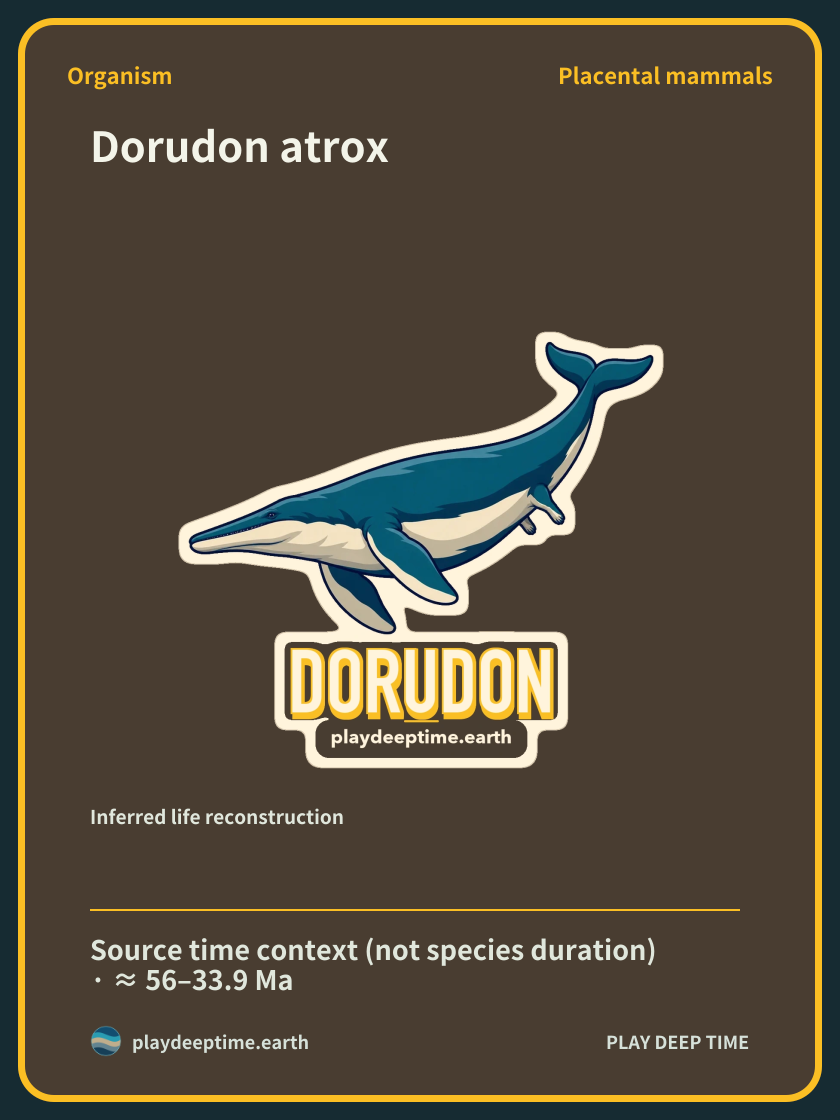
Dorudon atrox was an Eocene whale with a low, elongated head and flattened foreflippers. Small hind limbs also remained on the rear part of its body. Its marine whale body retained several traces of evolution.[2]
Loading illustration…
Key facts
The pelvis was separated from the spine, and small hind limbs projected outside the body. This differed from the large limbs that once supported body weight. The positions of small bones allow us to examine bodily changes from land mammals to marine whales.[2]
Time and place
It is studied from middle and late Eocene material, an interval around 48–34 million years ago. Fossils from Wadi Al-Hitan in present-day Egypt are also included in museum skeletal material.[3][4]
The time range describes source context, not the complete duration of this species.
Size, form and skeleton
It is compared through its low, elongated head, flattened foreflippers, and a shorter, more compact trunk than Basilosaurus. A small pelvis and hind limbs remain at the rear of the body. A museum description gives an estimated body length of about 5 m.[2]
Loading illustration…
Habitat and reproduction
It was a whale that lived in water. The museum explains interpretations of propulsion by the tail and steering by the foreflippers. The shapes of the tail vertebrae are also used to reconstruct the tail flukes.[2][1]
Fossil discovery
University of Michigan specimen UMMP-NH VP118183 is a composite skeleton assembled from several sets of material from Wadi Al-Hitan. Museum information shows the head, foreflippers, and small hind limbs together. It illustrates how partial fossils are compared to understand the whole body.[2][3]
References
Research questions
How did shrinking whale hind limbs relate to other parts of the body? Researchers compare the pelvis separated from the spine, the small limbs, and the propulsive tail. Dorudon invites exploration of how mammalian bodies changed for marine life.[2][1]
Observation
Move your gaze from the long, low head to the flattened foreflippers. Then consider the small limbs at the rear of the body and the tail: major changes and small traces coexist in a single body.[2]
Related organisms
 Basilosaurus isisPlacental mammalsSource time context (not species duration) · ≈ 66–23 Ma
Different bodies among whales
Compare the bodies of Dorudon atrox and Basilosaurus. Dorudon atrox: an Eocene whale with a low, elongated head and flattened foreflippers. Basilosaurus: Basilosaurus isis was a large Eocene whale with an elongated body.