Organism · Ray-finned fishes
Dorypterus hoffmanni
Source time context (not species duration) · ≈ 299–252 Ma
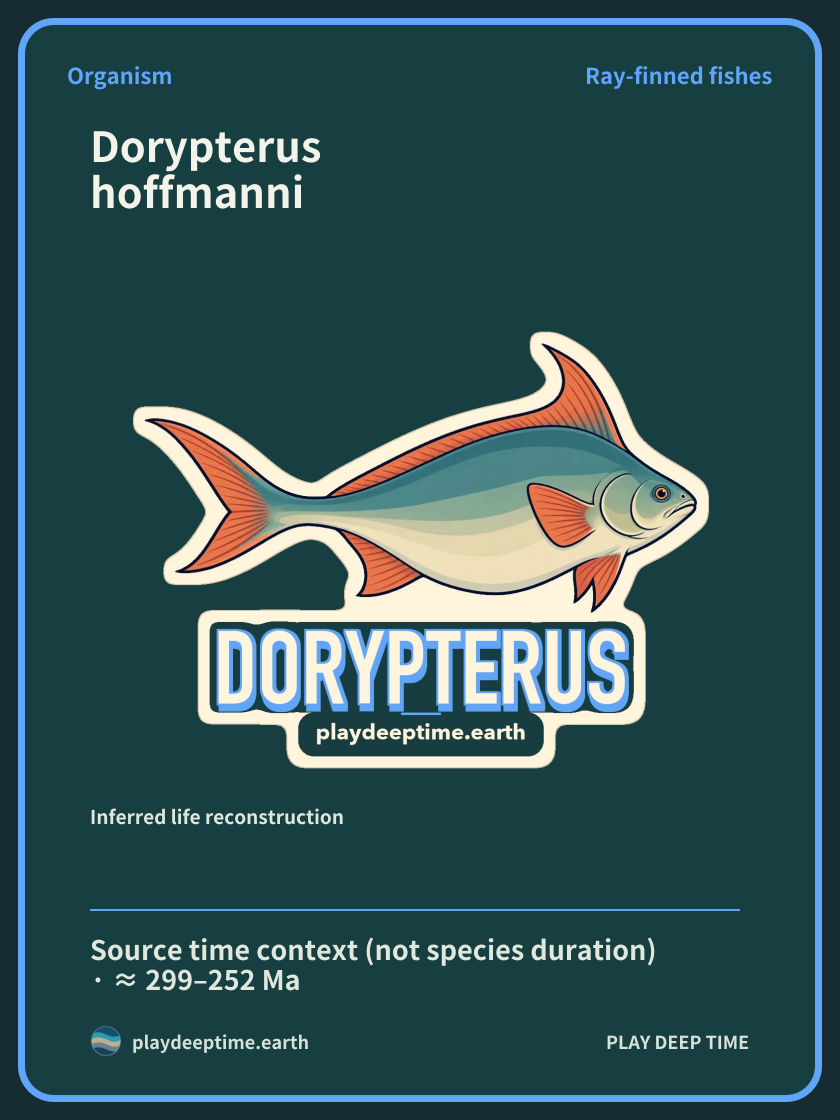
Inferred life reconstruction
Dorypterus hoffmanni
Overview
Dorypterus hoffmanni is a fish with a deep, laterally flattened body and a tall anterior dorsal fin. It is known from Late Permian material at Middridge. Its distinctive outline runs from a small head to a large fin.[1]
Loading illustration…
Key facts
The dorsal fin is very tall at the front, with a long base continuing rearward. Height and length can be examined separately even within one fin.[1]
Time and place
It is a Late Permian fish from Middridge in present-day Britain. The Permian as a whole was roughly 300–250 million years ago. The report introduces its features alongside several fishes from the same locality.[1][2]
The time range describes source context, not the complete duration of this species.
Size, form and skeleton
The trunk is deep and laterally flattened. The front of the dorsal fin rises high, with a long base extending behind. The pelvic fins are positioned far forward near the throat, and the scale covering is described as greatly reduced.[1]
Dorypterus hoffmanni is introduced as a small fish about 11cm long. This body length was presented in a British fossil-fish report comparing the German Kupferschiefer assemblage.[5]
Loading illustration…
Habitat and reproduction
Where on a fish’s body are its fins positioned? Dorypterus allows comparison of a tall dorsal fin with pelvic fins near the front of the body. Examining body depth alongside each fin’s position makes the distinctive construction clearer.[1]
Fossil discovery
A 1999 report on British fossil fishes introduced a whole-body reconstruction of Dorypterus following earlier research. It provides a view of the connected arrangement of a deep body, tall dorsal fin, and anterior pelvic fins.[1]
References
Research questions
What is missed when looking only at the tall dorsal fin? The depth of the trunk, rearward-continuing fin base, and anterior pelvic fins need to be examined together. Observation can broaden from one conspicuous part to the construction of the whole body.[1]
Observation
Follow the raised front of the dorsal fin along its long rearward base. Then examine the deep, flattened trunk and pelvic fins below the throat to compare the upper and lower body.[1]
Related organisms
 Palaeoniscum freieslebeniRay-finned fishesSource time context (not species duration) · ≈ 299–252 Ma
Fishes of Late Permian Middridge
Palaeoniscum and Dorypterus are known from Late Permian material at Middridge in present-day Britain. Compare an elongated body with a deep, flattened one.