Organism · Ray-finned fishes
Palaeoniscum freieslebeni
Source time context (not species duration) · ≈ 299–252 Ma
Inferred life reconstruction
Palaeoniscum freieslebeni
Overview
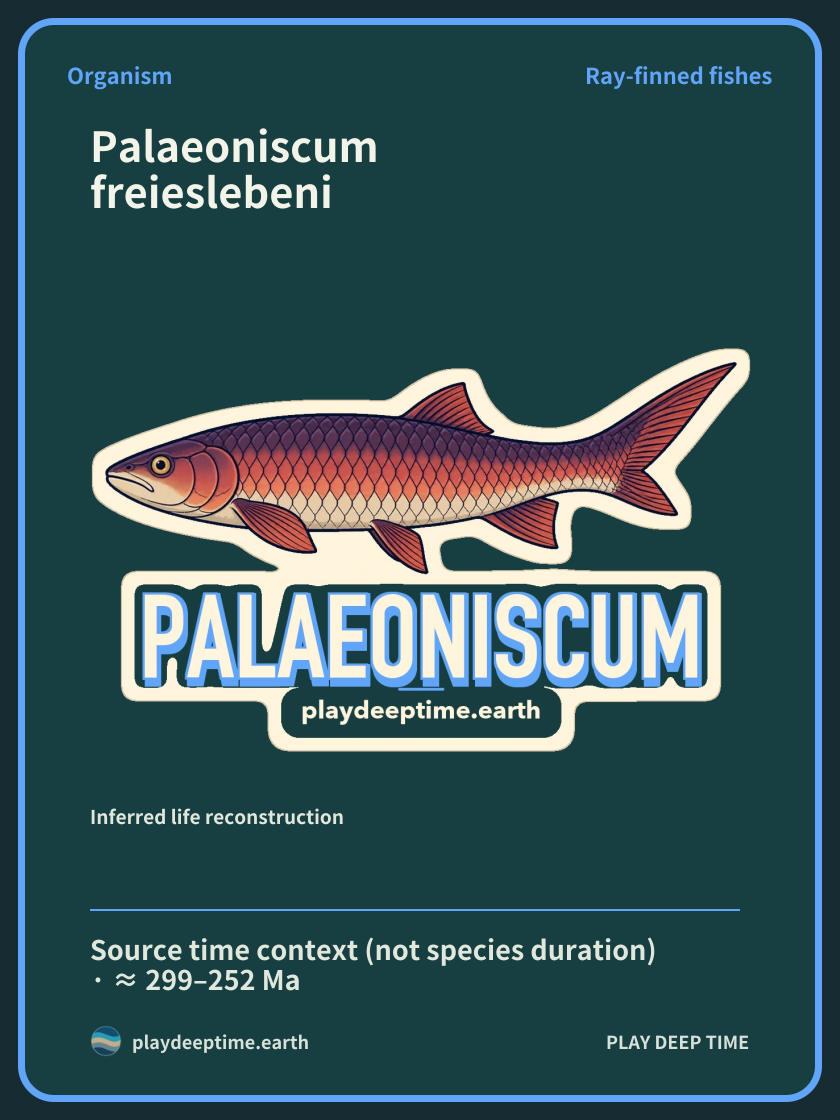
Palaeoniscum freieslebeni is a fish known for an elongated spindle-shaped body and a tail with different upper and lower parts. Late Permian material from Middridge was studied. The outline from body to tail can be examined together with hard scales.[1]
Loading illustration…
Key facts
The published reconstruction depicts a tail with an elongated upper lobe. The asymmetrical tail and elongated body connect in one construction.[1]
Time and place
Late Permian material from the Marl Slate at Middridge in present-day Britain was studied. The Permian as a whole was roughly 300–250 million years ago. Deep-bodied, flattened Dorypterus is also known from the same locality and period, allowing comparison of the two forms.[1][3][2]
The time range describes source context, not the complete duration of this species.
Size, form and skeleton
Paired and unpaired fins are arranged on an elongated spindle-shaped trunk. Behind is an asymmetrical tail with a long upper lobe. Hard, diamond-shaped scales are also known as a body feature.[1]
In the German Kupferschiefer assemblage introduced by a British fossil-fish report, Palaeoniscum freieslebeni body lengths ranged from about 5.5 to 32cm, with many individuals around 10–18cm. Small and large individuals can be compared within one fossil assemblage.[4]
Loading illustration…
Habitat and reproduction
Did all fishes at the same locality have similar bodies? The Middridge material introduces the elongated body of Palaeoniscum alongside the deep, flattened body of Dorypterus. Different constructions known from the same time and region can be compared.[1][3]
Fossil discovery
A 1999 report on British fossil fishes introduced whole-body and head reconstructions alongside the Middridge material. These allow separate examination of the broad body outline and the jaws and gill cover of the head.[1]
References
Research questions
What appears differently in whole-body and head illustrations? One helps reveal the positions of fins and tail; the other clarifies relationships among eyes, jaws, and gill cover. This is observation of the same organism at different scales.[1]
Observation
Move your gaze from the elongated body to the tail with unequal upper and lower parts. Then examine diamond-shaped scales and fin positions to connect the broad outline with surface features.[1]
Related organisms
 Dorypterus hoffmanniRay-finned fishesSource time context (not species duration) · ≈ 299–252 Ma
Fishes of Late Permian Middridge
Palaeoniscum and Dorypterus are known from Late Permian material at Middridge in present-day Britain. Compare an elongated body with a deep, flattened one.