Organism · Dinosaurs
Gallimimus bullatus
Source time context (not species duration) · ≈ 143–66 Ma
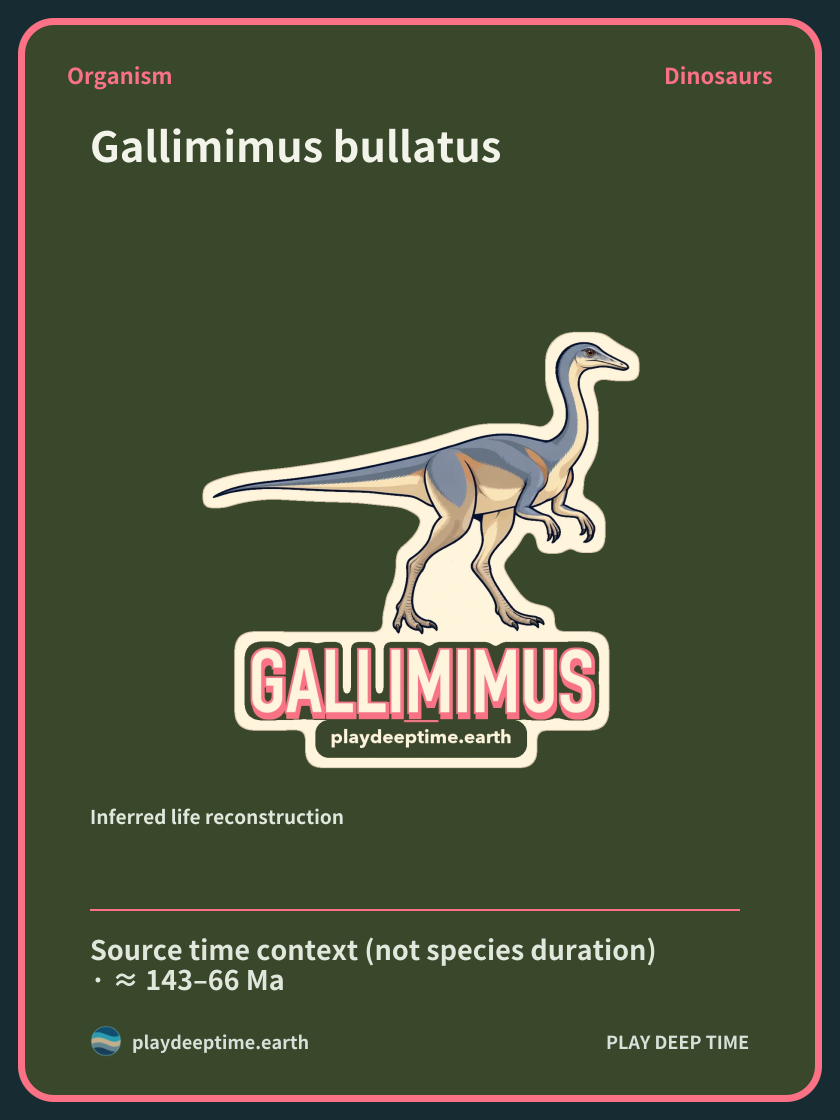
Inferred life reconstruction
Gallimimus bullatus
Overview
Gallimimus bullatus is an ornithomimosaur with a long, flattened snout and short hands. It is known from the Late Cretaceous Nemegt Formation in Mongolia. Juveniles, adults, and several skeletons allow its body features to be compared.[1]
Loading illustration…
Key facts
Height can vary greatly with growth even within one species. Literature gives a hip height of approximately 2 m for adults and approximately 0.5 m for juveniles. These values compare pelvic height, not height to the top of the head or body length.[1]
Time and place
It is studied through Maastrichtian material of the Late Cretaceous from the Nemegt Formation in present-day Mongolia. The Maastrichtian is the final stage of the Cretaceous. The Cretaceous as a whole spans roughly 140–66 million years ago.[1][2]
The time range describes source context, not the complete duration of this species.
Size, form and skeleton
A long, flattened snout and relatively short hands are described as characteristic. Research examined three nearly complete skeletons. Several individuals allow head, forelimb, and growth-stage differences to be viewed side by side.[1]
Loading illustration…
Habitat and reproduction
Comparing short hands with other body regions reveals differences among ornithomimosaurs. A 2006 study discussed several ornithomimosaurs known from the Nemegt Formation together. Relatives from the same formation could have differently constructed bodies.[1]
Fossil discovery
Three nearly complete skeletons provided evidence for describing Gallimimus. A 2006 study compared its head and hand features with other ornithomimosaurs. Material from several individuals makes the body of one species more concrete.[1]
References
Research questions
How can ornithomimosaurs from the same formation be distinguished? Researchers compare snout and hand lengths with the features of each skeleton. Separating juvenile–adult differences helps distinguish species variation from growth-related change.[1]
Observation
Move your gaze from the long, flattened snout to the short hands. Then picture hip height to consider head and forelimb form alongside size differences during growth.[1]
Related organisms
 Deinocheirus mirificusDinosaursSource time context (not species duration) · ≈ 143–66 Ma
Late Cretaceous dinosaurs of the Nemegt Formation
Gallimimus and Deinocheirus are known from Late Cretaceous material in the Nemegt Formation of present-day Mongolia. Compare different dinosaur bodies from the same formation and time side by side.