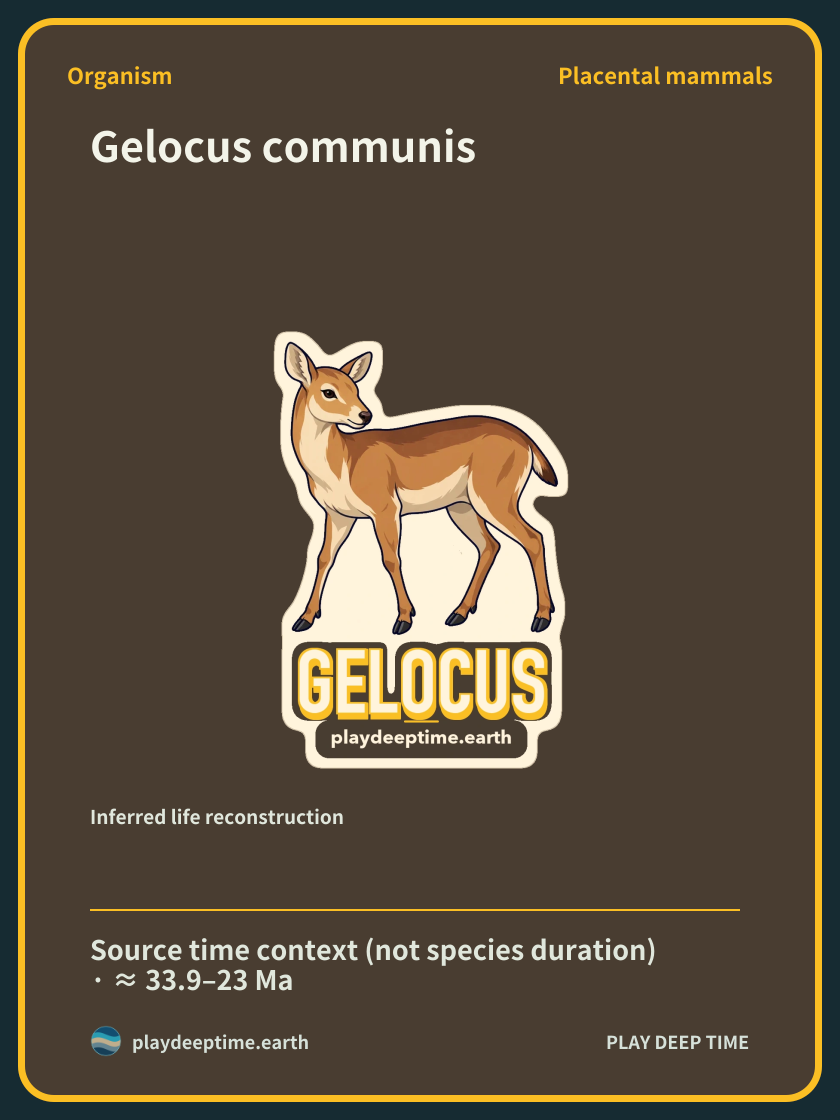
Organism · Placental mammals
Gelocus communis
Source time context (not species duration) · ≈ 33.9–23 Ma
Inferred life reconstruction
Gelocus communis
Overview
Gelocus communis is an extinct Oligocene ruminant. It appears in studies comparing cranial and limb features and is the type species of Gelocus. The different arrangements of bones in the forefeet and hind feet are intriguing.[1][2]
Loading illustration…
Key facts
Forefoot and hind-foot bones were not joined in the same way. The diagnosis of Gelocus describes separate third and fourth metacarpals in the forefoot, but fused corresponding metatarsals in the hind foot. Comparing internal bones reveals differences even among four seemingly similar limbs.[1]
Time and place
It appears in research on Oligocene ruminants of western Europe. Publications record contexts such as Ronzon and the mammalian biozone MP21. The Oligocene spanned approximately 34–23 million years ago.[2][3]
The time range describes source context, not the complete duration of this species.
Size, form and skeleton
Gelocus heads are described as having shortened snouts and bony-enclosed eye sockets. Patterns of fusion in forefoot and hind-foot metapodials also contribute to the genus diagnosis. Different features can be explored in the head and limbs.[1]
This ruminant of Oligocene Europe can also be understood through fossil jaws and teeth. The last lower molar of one jaw specimen from Quercy, France, was approximately 1.2 cm long. Shapes preserved in one small tooth help distinguish similar ancient ruminants.[4]
Loading illustration…
Habitat and reproduction
Separate or fused metapodials invite comparison of weight-supporting limb arrangements. A 2014 study examined the postcranial skeleton of Gelocus alongside other ruminants. This evidence explores how forefeet and hind feet acquired different structures among related groups.[1][2]
Fossil discovery
Gelocus communis has served as the type species for describing Gelocus. A 2014 study included it in a phylogenetic analysis and transferred material formerly called Gelocus quercyi to Mosaicomeryx. Fossils once grouped under a familiar genus name were thus separated again.[2]
References
- Taxonomic study of ruminants from the Oligocene–Early Miocene of western Europe
- 2014 study — Reassessment of gelocid skeletons and classification
- International Commission on Stratigraphy (2024) — Geological time chart
- Mennecart (2012), The Ruminantia from the Oligocene to the Early Miocene of Western Europe
- Croitor (2013) — Morphology and taxonomic problems of leptobovines
- Hooijer (1958) — Comparing skulls of Leptobos falconeri
Research questions
Do similar ruminants all belong to the same genus? Comparing several cranial, dental, and limb features allows relationships and generic boundaries to be reassessed. Research on Gelocus invites consideration of the link between bodily resemblance and classification.[2]
Observation
After examining the snout and eye sockets, imagine the positions of metapodials in the forefeet and hind feet. Comparing them side by side reveals how differences in bone fusion help identify this animal.[1]
Related organisms
 Leptobos falconeriPlacental mammalsFossil record age bounds · ≈ 3.6–2.58 Ma
Different bodies among ruminants
Explore the bodies and backgrounds of Gelocus communis and Leptobos falconeri together. Gelocus communis is an extinct Oligocene ruminant. It appears in studies comparing cranial and limb features and is the type species of Gelocus. Leptobos falconeri is an ancient bovine known from Siwalik fossils. Researchers described it as a large bovid with a slender, lightly built appearance.