Organism · Cnidarians
Heliolites porosus
Source time context (not species duration) · ≈ 440–370 Ma
Inferred life reconstruction
Heliolites porosus
Overview
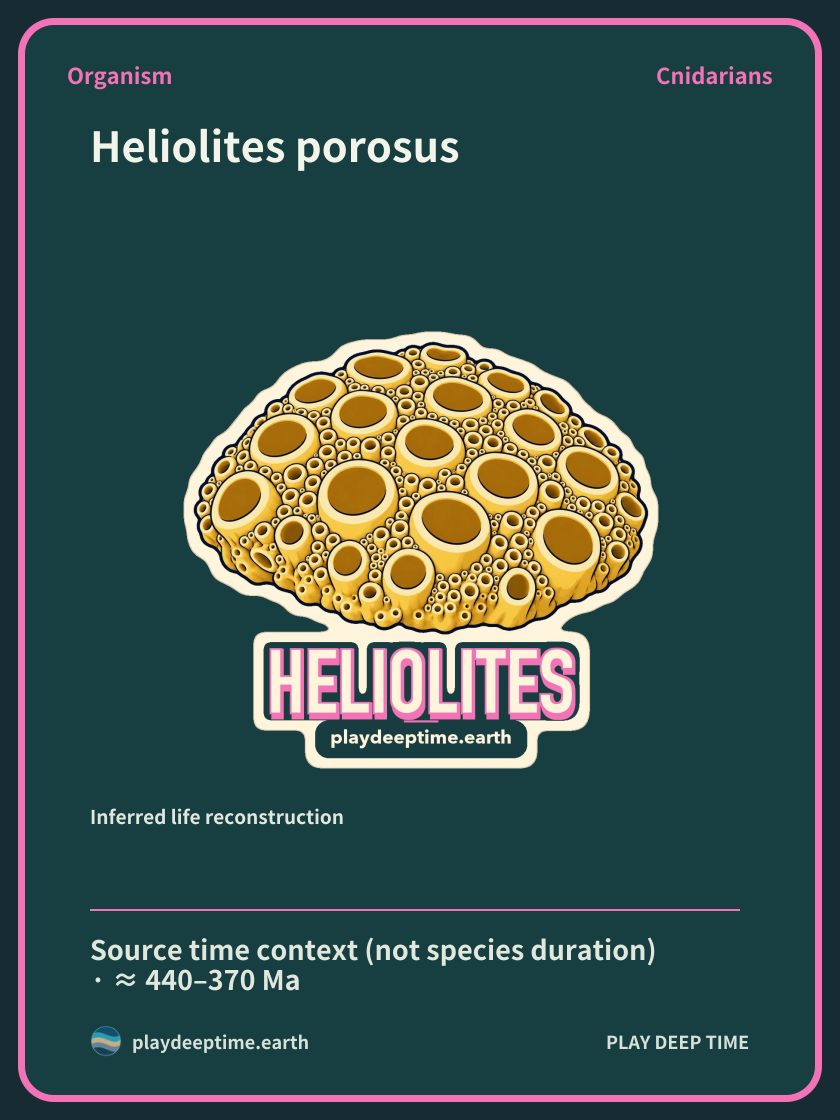
Heliolites porosus is an ancient coral whose tubes of different sizes form a rigid colony. Small tubes fill the spaces between larger round ones. Even a fossil resembling a rock contains an intricate structure built by small units together.[1]
Loading illustration…
Key facts
Cutting a colony across and lengthwise reveals different patterns. Large round tubes and the smaller tubes between them can be distinguished in section. Unlike the outer outline alone, internal sections reveal the coral’s construction.[1]
Time and place
This animal features in studies of Devonian marine corals. The Devonian spanned approximately 420–360 million years ago. Material from the Cantabrian Mountains of present-day Spain and the Anti-Atlas of present-day Morocco has been studied.[1][2][3]
The time range describes source context, not the complete duration of this species.
Size, form and skeleton
Large round tubes and the small coenenchymal tubes between them form a rigid colony. Transverse sections allow comparison of tube size and spacing, while longitudinal sections show their extended structure. Small units together built a large coral skeleton.[1]
A colony of Heliolites porosus is a skeleton built together by numerous small corals. One specimen from Devonian strata in Morocco measured 27.8 cm in diameter and 10.5 cm in height. Spacing between the small skeletal tubes varies even within the same colony, allowing changes in pattern to be followed across its surface.[4]
Loading illustration…
Habitat and reproduction
A study of Devonian reefs in Morocco describes an assemblage including this species. Groups of low, rounded coral colonies were interpreted in the context of the reef environment. The view expands from the skeleton of an individual coral to the ecology of the entire reef.[2]
Fossil discovery
Studies of the species described both transverse and longitudinal sections of specimens. In 2018, ecological research on the Aferdou el Mrakib reef in Morocco also examined an assemblage including this coral. The internal skeleton and the coral’s place within a reef tell stories at different scales.[1][2]
References
Research questions
How does the shape of a colony change as small tubes gather together? Researchers compare the arrangement of large and small tubes with related corals. Reading internal sections alongside the reef’s depositional setting helps explore ancient marine ecosystems.[1][2]
Observation
Look for the small tubes between the larger round ones. Picturing transverse and longitudinal sections separately makes it easier to understand how structures continue through the colony.[1]
Related organisms
 Hexagonaria davidsoniCnidariansFossil record age bounds · ≈ 443–372 Ma
Different bodies among corals
Explore the bodies of Heliolites porosus and Hexagonaria davidsoni together. Heliolites porosus: Heliolites porosus is an ancient coral whose tubes of different sizes form a rigid colony. Hexagonaria davidsoni: Hexagonaria davidsoni is a Devonian colonial coral whose neighboring corallites meet wall to wall.