Organism · Reptiles including birds
Hylonomus lyelli
Source time context (not species duration) · ≈ 359–299 Ma
Inferred life reconstruction
Hylonomus lyelli
Overview
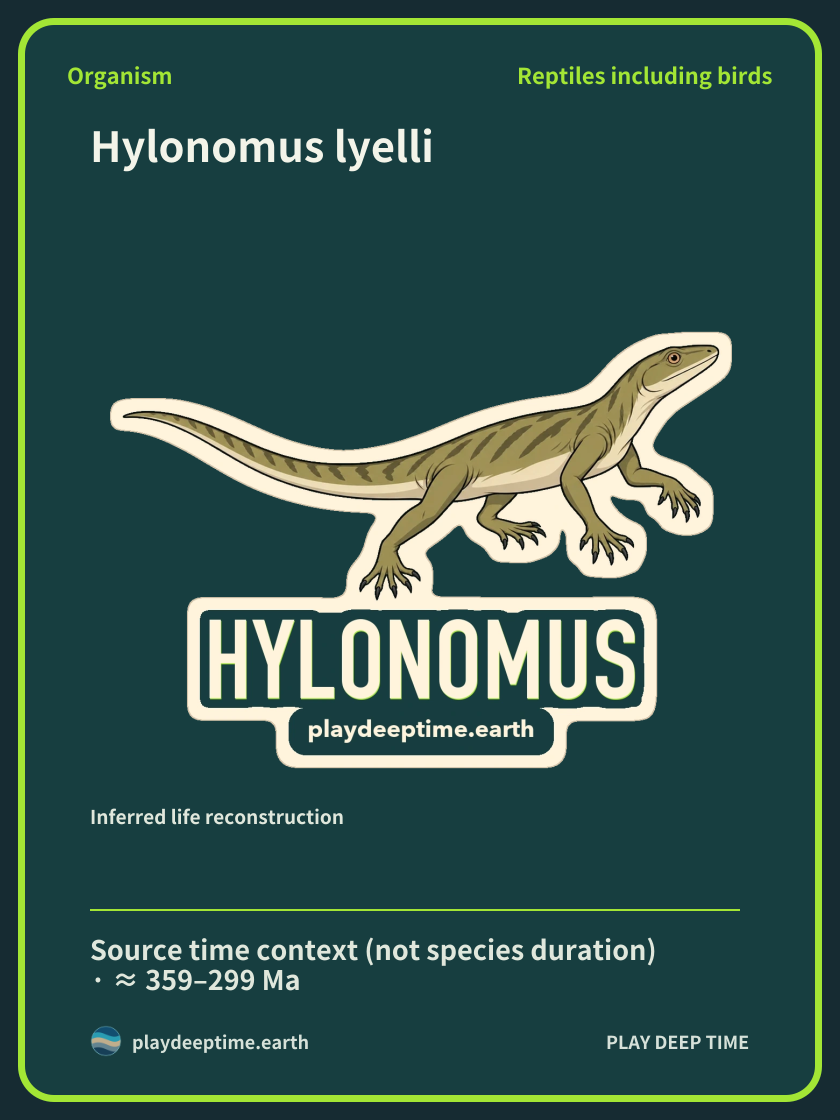
Hylonomus lyelli is a Carboniferous animal known for a small, lizard-like body and slender limbs. Its sharp teeth are described as clues to possible insect eating. It also appears in research questioning the relationships of early terrestrial vertebrates.[1]
Loading illustration…
Key facts
The reference specimen NHMUK R4168 continues to appear in later studies discussing age and phylogeny. This is an example of an old fossil becoming a reference for comparison again in new analyses.[2][3]
Time and place
A 2015 study treated the age of the body fossils from the Joggins Formation as roughly 319–318 million years ago. This is Carboniferous material. The Carboniferous as a whole spans roughly 360–300 million years ago.[3][5]
The time range describes source context, not the complete duration of this species.
Size, form and skeleton
Museum sources and related research describe a small, lizard-like body and slender limbs. Sharp teeth also provide clues for interpreting its life. The overall outline, limbs, and teeth can be examined at different scales.[1]
Loading illustration…
Habitat and reproduction
What might an animal with a small, lizard-like body have eaten? The museum explains the possibility of insect eating based on its sharp teeth. Small structures in the head lead to questions about possible food.[1]
Fossil discovery
A 2015 dating study addressed the reference specimen and the temporal position of the Joggins Formation. A 2025 phylogenetic analysis proposed placing Hylonomus outside the group descending from the common ancestor of living amniotes. This added a new question to the longstanding interpretation of it as an early reptile.[2][3]
References
- Natural History Museum, London — Hylonomus lyelli
- Jenkins et al. (2025) — Reassessment of early amniote relationships
- Benton et al. (2015) — Constraints on the timing of animal evolution
- Introduction to research on early reptile footprints
- International Commission on Stratigraphy (2024) — Geological time chart
- Berman et al. (2021) — The skeleton and movement of Eudibamus
- Berman et al. (2000) — An Early Permian reptile that ran on two legs
- Approximate size comparison — Hylonomus lyelli
Research questions
Can the relationships of the same fossil change in a new analysis? Hylonomus is discussed both as an early reptile and under a different phylogenetic placement. The choice of other animals with which its skeletal features are compared leads to research questions about relationships.[2]
Observation
Move your gaze from the small, lizard-like body to the slender limbs and sharp teeth. Examining the whole appearance together with small structures helps connect questions about form and life.[1]
Related organisms
 Eudibamus cursorisReptiles including birdsFossil record age bounds · ≈ 299–294 Ma
Slender bodies and long limbs of Paleozoic land animals
Examine together the different records of bodies and time preserved in these two organisms. Hylonomus: Hylonomus lyelli is a Carboniferous animal known for a small, lizard-like body and slender limbs. Its sharp teeth are described as clues to possible insect eating. A 2015 study treated the age of the body fossils from the Joggins Formation as roughly 319–318 million years ago. This is Carboniferous material. Eudibamus cursoris: Eudibamus cursoris is a small Permian reptile with a slender body, long limbs, and a very long tail. Its hind limbs, longer than its forelimbs, and its elongated feet are striking. It has been studied as Artinskian material of the Early Permian. The fossils came from the Tambach Formation at the Bromacker locality in the Thuringian Forest of present-day Germany.