Organism · Dinosaurs
Kentrosaurus aethiopicus
Source time context (not species duration) · ≈ 201–143 Ma
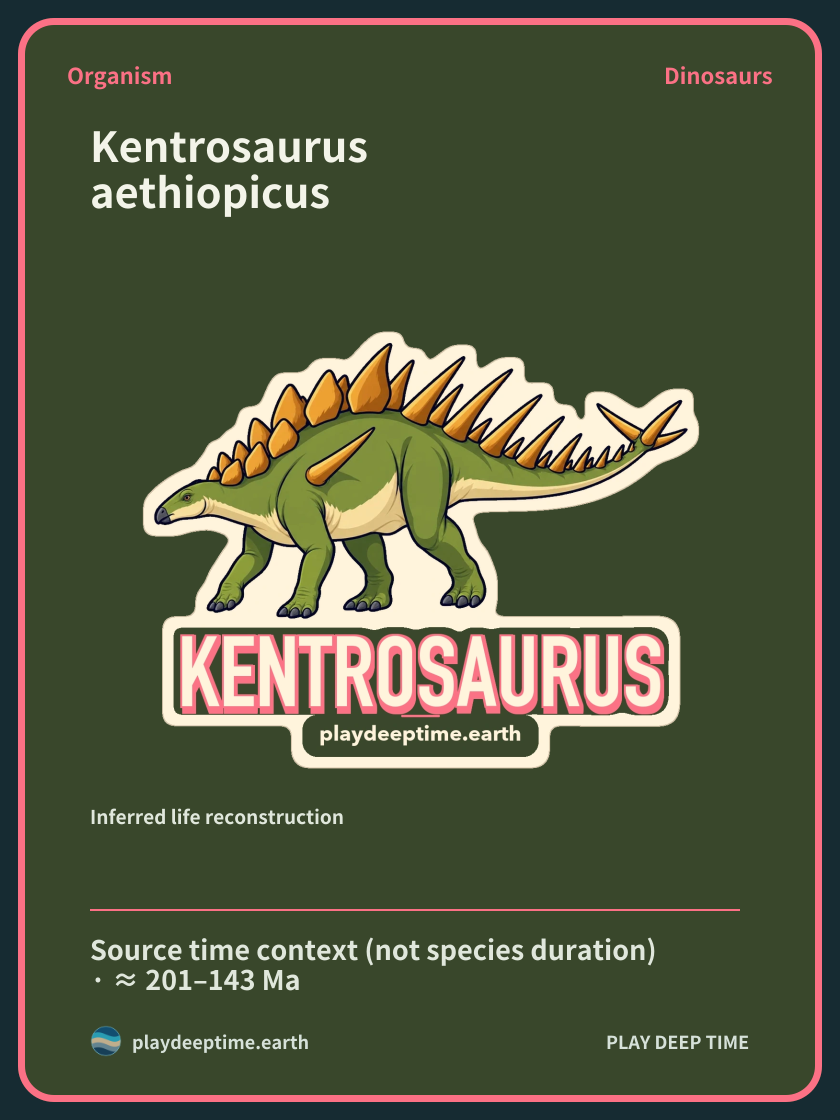
Inferred life reconstruction
Kentrosaurus aethiopicus
Overview
Kentrosaurus aethiopicus is a Late Jurassic stegosaur with bony plates and tail spines. Its outline draws the eye from back ornaments to the tail tip. A nearly complete tail has been particularly useful for studying how it used its body.[1]
Loading illustration…
Key facts
The fossil stories of the whole skeleton and tail are different. The study’s body skeleton combines several specimens, while the nearly complete tail comes from one individual. A particularly well-connected body region allows more specific questions to be investigated.[1]
Time and place
It is known from Late Jurassic material at Tendaguru in present-day Tanzania. Mallison’s study records the lectotype tail vertebrae as coming from Quarry St. The Jurassic spans roughly 200–140 million years ago.[1][2]
The time range describes source context, not the complete duration of this species.
Size, form and skeleton
Bony body plates and tail spines are characteristic. The researcher examined the articulations of tail vertebrae and terminal spines separately. Distinguishing body ornamentation from tail connections makes the research focus clearer.[1]
The Natural History Museum in London gives a body length of approximately 5 m in its account of the genus Kentrosaurus.[5]
Loading illustration…
Habitat and reproduction
The well-preserved tail provides a starting point for investigating stegosaur defenses. The researcher examined body use from the arrangement of the tail and spines. Bone connections and functional interpretations are considered together.[1]
Fossil discovery
Several Tendaguru specimens were used to assemble a whole skeleton. The nearly complete tail from one individual provided important separate evidence. A 2011 study used this material to examine the defensive capabilities of Kentrosaurus.[1]
References
- Mallison(2011). Defense capabilities of Kentrosaurus aethiopicus. Palaeontologia Electronica.
- International Commission on Stratigraphy (2024) — Geological time chart
- Taylor (2009) — Reassessment of Brachiosaurus and Giraffatitan
- Mallison (2011) — The tail and defensive function of Kentrosaurus
- Natural History Museum, London — Kentrosaurus
Research questions
How did a spiny tail connect with the body? Articulations of tail vertebrae and terminal spines can be compared together. Research narrows from the overall outline to connections among bones.[1]
Observation
Move your gaze from the back plates to the tail, then examine its terminal spines. Picture the sequence of tail vertebrae to consider ornamentation and function together.[1]
Related organisms
 Giraffatitan brancaiDinosaursSource time context (not species duration) · ≈ 201–143 Ma
Different Jurassic dinosaurs known from Tendaguru
Giraffatitan and Kentrosaurus are known from Late Jurassic fossils at Tendaguru. Compare a long-necked sauropod with a dinosaur bearing plates and spines within the same regional and temporal setting.