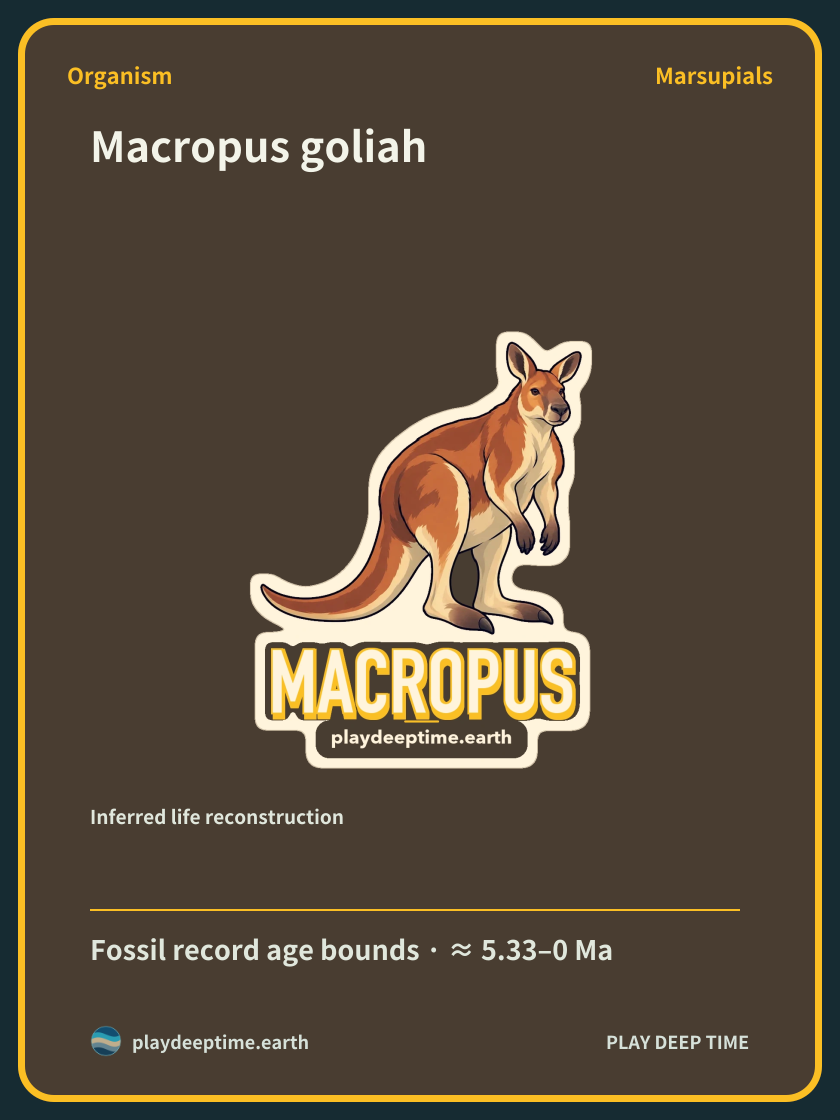
Organism · Marsupials
Macropus goliah
Fossil record age bounds · ≈ 5.33–0 Ma
Inferred life reconstruction
Macropus goliah
Overview
Macropus goliah is an extinct member of the kangaroo family also associated with the name Procoptodon goliah. Following its old name leads to research beginning with an upper jaw and molars. Small differences in teeth were clues for distinguishing the names of large animals.[1]
Loading illustration…
Key facts
The belief that a specimen had disappeared could begin with a printing error. The early description stated that the upper jaw had two molars, but a later reexamination pointed out that the type specimen, with three molars preserved, did exist. Correcting a misprinted line also restored the connection to the fossil.[1]
Time and place
A 1966 reexamination introduces type specimens from the Darling Downs as Late Pleistocene material. The Darling Downs are in present-day Queensland, Australia. Today’s place names lead us to the setting of ancient fossil kangaroos.[1]
The time range describes source context, not the complete duration of this species.
Size, form and skeleton
Molar patterns and structures are among the clues used to distinguish this animal. The 1966 study compared dental features in detail while rediagnosing the genus Procoptodon and several species within it. The teeth remaining in the upper jaw are both evidence for assigning a name and a small map for reading form.[1]
This large kangaroo, now called Procoptodon goliah, is described as reaching about 2m in height when standing in a normal posture. This is a different measure from the height it could reach with its forelimbs extended above its head.[3]
Loading illustration…
Habitat and reproduction
The fossil record of the Darling Downs is also connected to ancient waterways. Public university research material explains that material of goliah and other species grouped in Procoptodon was collected from river deposits in this region. Examining the sediments where bones were preserved offers clues to ancient landscapes.[2]
Fossil discovery
An upper-jaw fossil from the Darling Downs reached Richard Owen through Thomas Mitchell in 1844. A brief description and illustration subsequently appeared, making the name Macropus goliah known. This traces a discovery in the field into a researcher’s publication and museum specimen records.[1]
References
Research questions
How did the present name become established? Owen later grouped goliah and two other species in the genus Procoptodon. Scholars continued comparing teeth from this group and other fossil kangaroos and discussing the boundaries of the genus. Connecting old names is part of taxonomic research.[2]
Observation
In the upper-jaw fossil, first examine the row of molars. Then compare the patterns on the chewing surface of each tooth. Even a type specimen used to establish a name preserves small features worth checking again.[1]
Related organisms
 Bohra paulaeMarsupialsFossil record age bounds · ≈ 5.33–2.58 Ma
Different bodies among kangaroos
Explore the bodies of Macropus goliah and Bohra together. Macropus goliah: Macropus goliah is an extinct member of the kangaroo family also associated with the name Procoptodon goliah. Bohra: Bohra paulae is an extinct kangaroo known from hind-limb fossils.