Organism · Crocodylomorphs
Mahajangasuchus insignis
Source time context (not species duration) · ≈ 143–66 Ma
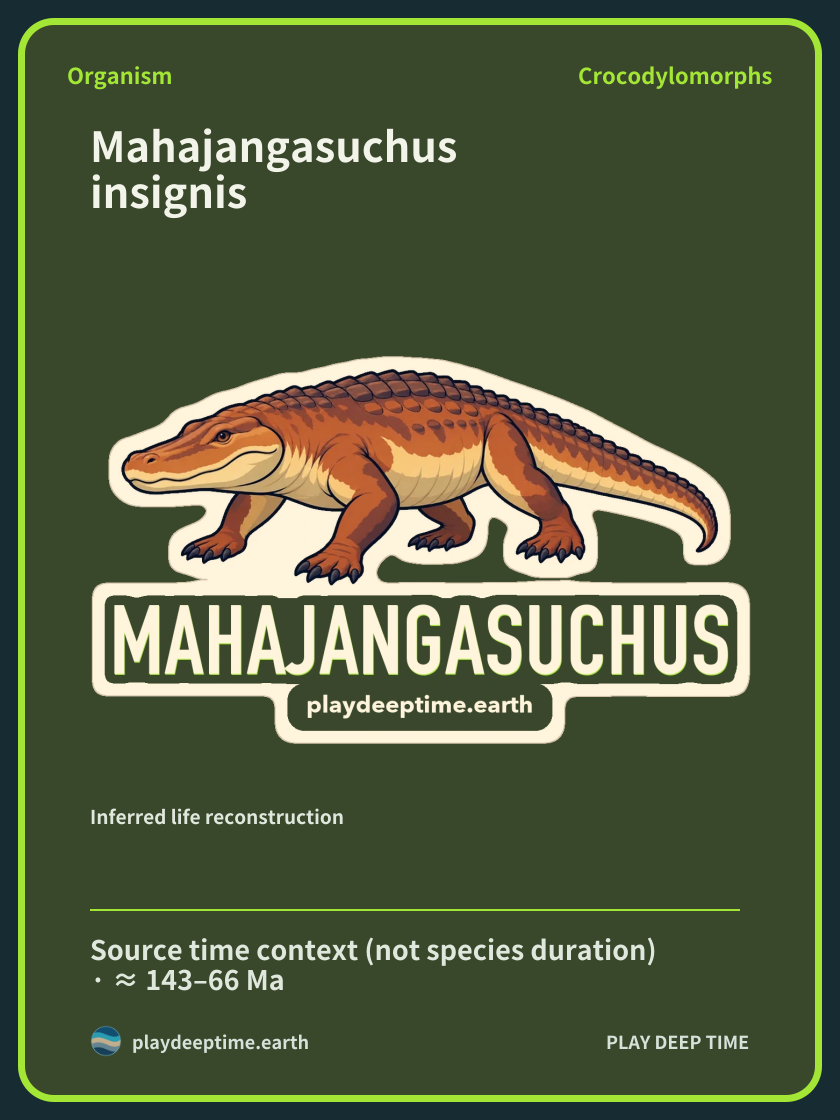
Inferred life reconstruction
Mahajangasuchus insignis
Overview
Mahajangasuchus insignis was a crocodyliform from latest Cretaceous Madagascar. The broad, rounded front of its jaws is striking. New skull material added detail to its face after the type skeleton had initially lacked a skull.[1][2]
Loading illustration…
Key facts
The palate can also be an important clue to close relationships. This animal's palate shows a structure familiar in living crocodilian groups. It raises the question of whether similar structures always arose along the same evolutionary path.[2][3]
Time and place
It is known from Madagascar near the end of the Late Cretaceous, around 70 million years ago. Fossils came from the Maevarano Formation in the Mahajanga Basin of the island's present-day northwest. They lead us into an island world inhabited by distinctive dinosaurs and crocodile relatives.[1][3]
The time range describes source context, not the complete duration of this species.
Size, form and skeleton
The front of the lower jaw is broad and rounded, and the anterior junction between the two sides is short. Postcranial bones and armour-like bony plates are also known. A nearly complete skull studied later reveals the face in greater detail than the jaws alone could provide.[1][2]
Mahajangasuchus insignis was a crocodile relative with a broad, robust head. A 2026 study calculated a total body length of about 2.9 m from a femur 29 cm long. This estimate may vary with the method used to reconstruct the skeleton.[20]
Loading illustration…
Habitat and reproduction
How can fossils reveal a crocodile-like life near water? The orientation of the eyes and nostrils, and the structure of the jaws and palate, can be compared with living animals. Recent studies use skulls of crocodile relatives such as Mahajangasuchus to explore their senses and habitats.[4][2]
Fossil discovery
In 1999, a new crocodyliform was introduced on the basis of jaws, teeth, postcranial bones and other material. A 2008 study added a newly discovered, nearly complete skull and other partial skulls. Even while studying the same animal, the focus of discovery keeps changing.[1][2]
References
- Buckley, G. A. & Brochu, C. A. (1999), “An enigmatic new crocodile from the Upper Cretaceous of Madagascar,” Special Papers in Palaeontology 60, pp. 149–175.
- Turner, A. H. & Buckley, G. A. (2008), “Mahajangasuchus insignis (Crocodyliformes: Mesoeucrocodylia) Cranial Anatomy and New Data on the Origin of the Eusuchian-Style Palate,” Journal of Vertebrate Paleontology 28(2), 382–408.
- Pochat-Cottilloux2025 — Non-semiaquatic adaptations of extinct crocodylomorphs
- 2024 — Predicting behavior in extinct reptiles from trigeminal osteological correlates
- Gilmore (1910), “Leidyosuchus sternbergii, a new species of crocodile from the Ceratops beds of Wyoming,” Proceedings of the U.S. National Museum 38, no. 1762.
- Lindblad et al.2022 — The Northern Crocodile from Saskatchewan’s lower Ravenscrag Formation
- Buckley, G. A. & Brochu, C. A. (1999), “An enigmatic new crocodile from the Upper Cretaceous of Madagascar,” Special Papers in Palaeontology 60, pp. 149–175.
- Turner, A. H. & Buckley, G. A. (2008), “Mahajangasuchus insignis (Crocodyliformes: Mesoeucrocodylia) Cranial Anatomy and New Data on the Origin of the Eusuchian-Style Palate,” Journal of Vertebrate Paleontology 28(2), 382–408.
- Pochat-Cottilloux2025 — Non-semiaquatic adaptations of extinct crocodylomorphs
- 2001 study — The description of Masiakasaurus
- 2011 study — New material of Masiakasaurus
- Buckley, G. A. & Brochu, C. A. (1999), “An enigmatic new crocodile from the Upper Cretaceous of Madagascar,” Special Papers in Palaeontology 60, pp. 149–175.
- Turner, A. H. & Buckley, G. A. (2008), “Mahajangasuchus insignis (Crocodyliformes: Mesoeucrocodylia) Cranial Anatomy and New Data on the Origin of the Eusuchian-Style Palate,” Journal of Vertebrate Paleontology 28(2), 382–408.
- Pochat-Cottilloux2025 — Non-semiaquatic adaptations of extinct crocodylomorphs
- Stony Brook University (2010) — Simosuchus researchers’ explanation
- International Commission on Stratigraphy (2024) — Geological time chart
- Buckley, G. A. & Brochu, C. A. (1999), “An enigmatic new crocodile from the Upper Cretaceous of Madagascar,” Special Papers in Palaeontology 60, pp. 149–175.
- Turner, A. H. & Buckley, G. A. (2008), “Mahajangasuchus insignis (Crocodyliformes: Mesoeucrocodylia) Cranial Anatomy and New Data on the Origin of the Eusuchian-Style Palate,” Journal of Vertebrate Paleontology 28(2), 382–408.
- Pochat-Cottilloux2025 — Non-semiaquatic adaptations of extinct crocodylomorphs
- Paiva et al. (2026) — Body-length estimates for crocodile relatives
Research questions
Does a similar palate imply close relationship, or adaptation to similar functions? Researchers analyse several cranial features together to examine both possibilities. This Madagascan animal shows how varied crocodyliform anatomy could become.[3]
Observation
Examine the broad front of the jaws, the back of the skull and the body's bony plates together.[1][2]
Related organisms
 Borealosuchus sternbergiiCrocodylomorphsSource time context (not species duration) · ≈ 72–63 Ma
Faces of different ancient crocodyliforms
Examine the heads and jaws of Borealosuchus and Mahajangasuchus in turn. Material from the latest Cretaceous–Paleocene of present-day North America and the latest Cretaceous of Madagascar allows comparison of different snout and anterior jaw outlines.
 Masiakasaurus knopfleriDinosaursFossil record age bounds · ≈ 72.2–66 Ma
A dinosaur and a crocodyliform from the same Maevarano Formation
Masiakasaurus and Mahajangasuchus are known from latest Cretaceous material in the Maevarano Formation of present-day northwestern Madagascar. Examine the dinosaur's forward-inclined front teeth and the crocodyliform's broad, rounded lower jaw, comparing different animals recorded in the same formation.
 Simosuchus clarkiCrocodylomorphsSource time context (not species duration) · ≈ 143–66 Ma
Different faces of Madagascar's ancient crocodyliforms
Simosuchus and Mahajangasuchus are represented by latest Cretaceous material from present-day Madagascar. Examine the blunt snout and leaf-shaped teeth of one and the broad, rounded front of the lower jaw of the other to compare diverse crocodyliform faces.