Organism · Dinosaurs
Mamenchisaurus youngi
Source time context (not species duration) · ≈ 201–143 Ma
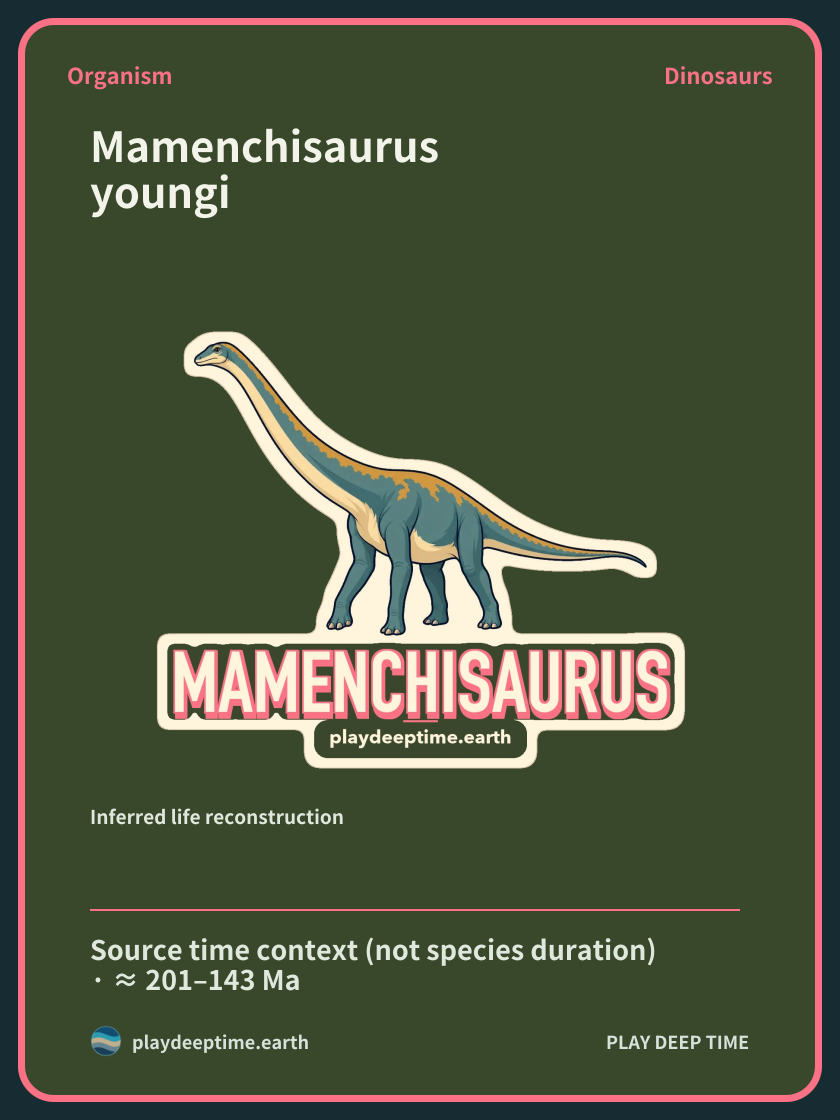
Inferred life reconstruction
Mamenchisaurus youngi
Overview
Mamenchisaurus youngi was a sauropod known for a small head, long neck, and broad trunk. Descriptions of a specimen from present-day Sichuan convey its body features. There is much to examine in the skull, teeth, and limbs as well as the long neck.[1]
Loading illustration…
Key facts
The skull is described as relatively tall and lightly built, with spoon-shaped teeth. The small head at the end of the long neck also contains a distinctive arrangement.[1]
Time and place
Late Jurassic material from the Upper Shaximiao Formation in present-day Sichuan, China, has been studied. The Jurassic as a whole spans approximately 200–140 million years ago. The description associated with ZDM0083 considers the skull and body together.[1][2]
The time range describes source context, not the complete duration of this species.
Size, form and skeleton
A tall, lightly built skull and spoon-shaped teeth lead into a long neck and broad trunk. The four limbs are described as relatively long and slender, with small hands and feet. Tail vertebrae are described in anterior, middle, and posterior regions.[1]
The original 1996 description gave a reconstructed body length of about 14 m.[1]
Loading illustration…
Habitat and reproduction
What can be found in the head when examining a long-necked dinosaur? Mamenchisaurus youngi allows skull height and tooth shape to be compared together. Observation can narrow from the impression of the whole neck to tiny structures inside the jaws.[1]
Fossil discovery
The original 1996 description is also available through Will Downs’s 2000 translation. The translated record describes features from the skull and teeth through the neck, trunk, limbs, and tail. It illustrates research in another language enabling broader comparisons.[1]
References
Research questions
How do researchers divide an elongated body for description? They examine the skull, neck, limbs, and several tail regions in sequence. Observation moves from the whole body to individual parts and back again.[1]
Observation
Move your gaze from the small head and spoon-shaped teeth to the long neck. Examining the broad trunk, slender limbs, small hands and feet, and tail allows several body regions to be compared together.[1]
Related organisms
 Giraffatitan brancaiDinosaursSource time context (not species duration) · ≈ 201–143 Ma
Different bodies among sauropods
Compare the bodies and backgrounds of Mamenchisaurus youngi and Giraffatitan. Mamenchisaurus youngi: a sauropod known for a small head, long neck, and broad trunk, with body features conveyed by a specimen from present-day Sichuan. Giraffatitan: Giraffatitan brancai was a sauropod with conspicuously high shoulders and a long neck. A relatively short trunk connected to the elevated front of the body.