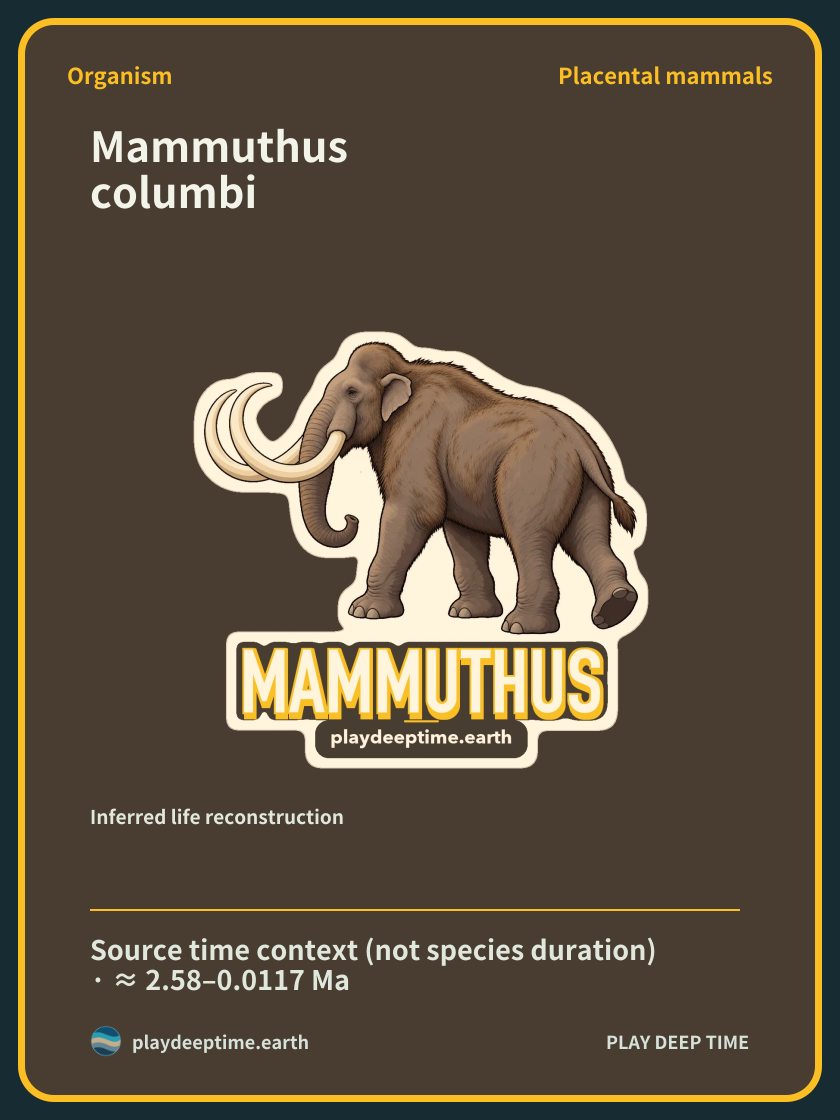
Organism · Placental mammals
Mammuthus columbi
Source time context (not species duration) · ≈ 2.58–0.0117 Ma
Inferred life reconstruction
Mammuthus columbi
Overview
The Columbian mammoth is a large member of the elephant family with a long trunk and long, curved tusks. It is known from Pleistocene fossils in North America. We can examine its weight-bearing legs together with the trunk used to handle food.[1]
Loading illustration…
Key facts
Even a complete museum skeleton can combine several kinds of evidence. The museum account explains that only about 20% of the Richland skeleton consists of the original surviving bones. Comparisons with other specimens and mirror-image replicas filled out the rest.[2]
Time and place
It is a mammoth known from ice-age North America. The Pleistocene spanned approximately 2.6 million to 12,000 years ago. Material from the present-day western USA can be compared with fossils from La Brea in Los Angeles.[1][3]
The time range describes source context, not the complete duration of this species.
Size, form and skeleton
National park material states that adult males could reach approximately 4 m at the shoulder. A long trunk, strongly curved tusks, and sturdy legs are characteristic. Considering body height separately from tusk length helps convey the proportions of a large animal.[1]
Loading illustration…
Habitat and reproduction
The institution explains that it ate varied plants, mainly grasses. Its long trunk is connected with handling vegetation. Comparison with mastodons from the same fossil locality allows exploration of different bodies and lives among ice-age elephant relatives.[1]
Fossil discovery
Most of the leg bones and parts of the skull and lower jaw survived in the Richland skeleton. The museum completed the mount using three-dimensional technology and comparisons with other specimens. Partial bones became the starting point for understanding the whole form of a giant animal.[2]
References
Research questions
How can separately preserved bones be connected to their original positions? Left and right forms are compared together with proportions in other specimens. The mammoth exhibit shows the meeting of real bones and three-dimensional reconstruction research.[2]
Observation
Move your gaze from the strongly curved tusks to the long trunk, forelegs, and body. Examine the legs and feet supporting a large animal with its head held high.[1]
Related organisms
 Mammut americanumPlacental mammalsSource time context (not species duration) · ≈ 2.58–0 Ma
Two elephant relatives from La Brea
Columbian mammoth and American mastodon fossils are known from La Brea in present-day Los Angeles, USA. Examine their curved tusks and bodies side by side to compare these ice-age elephant relatives.
 Aenocyon dirusPlacental mammalsSource time context (not species duration) · ≈ 2.58–0.0117 Ma
Mammals of ice-age La Brea
Dire wolf and Columbian mammoth fossils are known from La Brea in present-day Los Angeles. Compare the diverse bodies from the same locality side by side.