Organism · Placental mammals
woolly mammoth
Source time context (not species duration) · ≈ 2.58–0 Ma
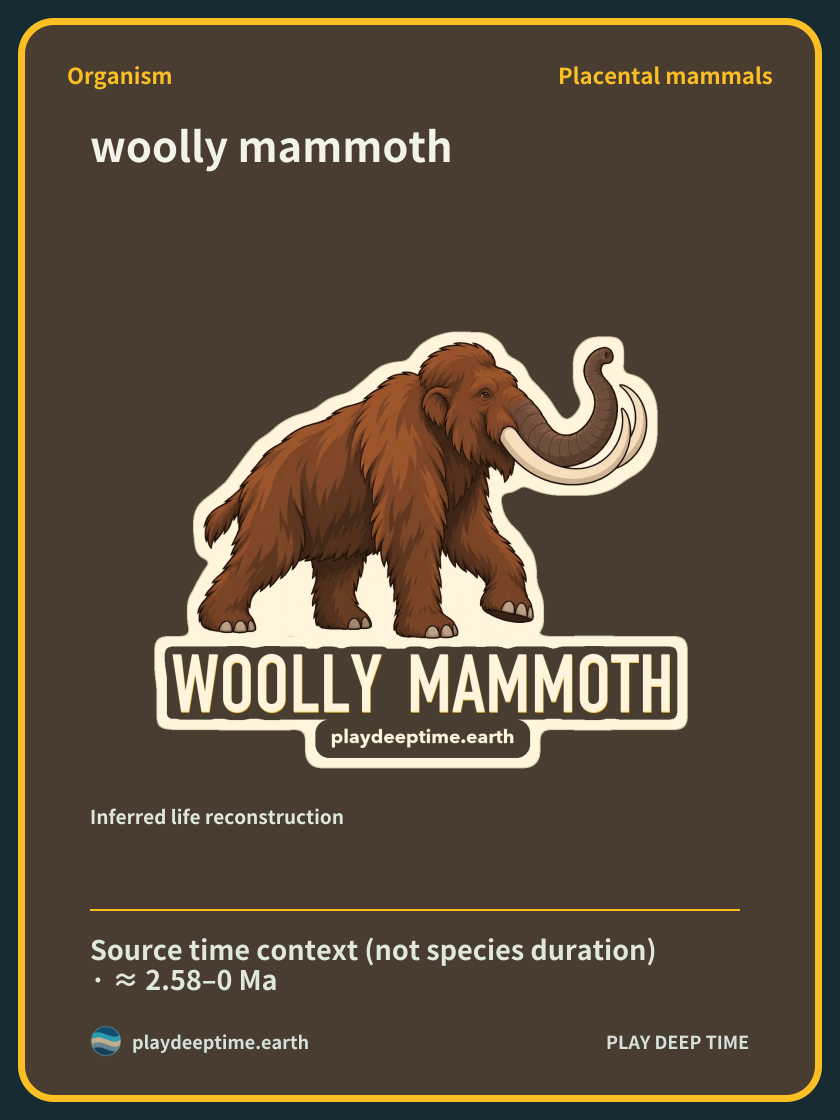
Inferred life reconstruction
Mammuthus primigenius
Overview
This ice-age elephant relative had long, curving tusks and thick fur. The woolly mammoth comes to life more vividly when pictured in ancient grass-rich plains than in a wasteland covered only in snow.[1]
Loading illustration…
Key facts
Not all mammoths were shaggy. The woolly mammoth appeared late in the long evolutionary history of mammoths. Rather than an ancestor that turned into today’s elephants, it was another branch of the larger elephant-family tree.[1]
Time and place
It is an emblematic animal of the northern continents during Quaternary glacial times. Traces across several regions of Eurasia and North America reveal where it lived as climate and vegetation changed.[1]
The time range describes source context, not the complete duration of this species.
Size, form and skeleton
Its back slopes down behind high shoulders, and it has small ears and a short tail. The tusks curve in a spiral rather than simply bending in one direction. It evokes a large, thickly furred body with a shoulder height of roughly 3 m.[1]
Loading illustration…
Habitat and reproduction
It used environments rich in grasses and other plants. Thick fur did not mean that it always lived in deep snow. Land where food plants grew and grass was accessible supported this giant herbivore’s life.[1]
Fossil discovery
Teeth are as important as enormous tusks in mammoth research. Comparing tooth shapes helps distinguish mammoth species and investigate the history of their movements. Beyond the shaggy image of one species lies the history of many mammoths.[1]
References
Research questions
How did a body suited to cold environments develop? Comparing other mammoth species and living elephants reveals differences in fur, ears, tusks, and teeth. Environmental and bodily changes are studied together in this animal.[1]
Observation
In the illustration, examine not only the fur but also the back descending behind the shoulders and the curvature of the tusks. Within the familiar image of an ice-age animal, look for differences among elephant relatives.[1]
Related organisms
 woolly rhinocerosPlacental mammalsSource time context (not species duration) · ≈ 2.58–0.0117 Ma
Large neighbors of ice-age grasslands
The woolly mammoth and woolly rhinoceros are animals encountered together in accounts of open ice-age grasslands. Compare the tusks of an elephant relative with the horns of a rhinoceros relative and picture an ancient environment used by different bodies.