Organism · Living jawless fishes
Mesomyzon mengae
Source time context (not species duration) · ≈ 143–66 Ma
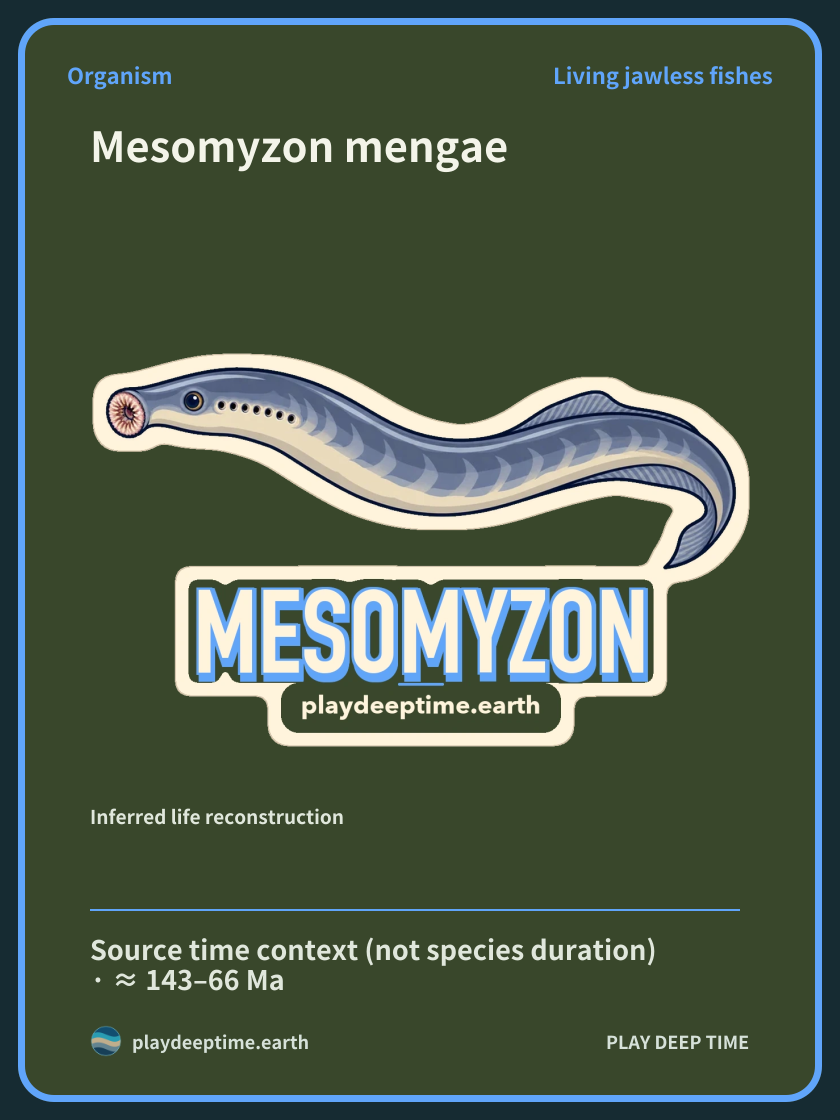
Inferred life reconstruction
Mesomyzon mengae
Overview
Mesomyzon mengae is a fossil lamprey from Early Cretaceous freshwater deposits. An elongated snout, round oral disc, gill region, and trunk muscle segments are described. It invites examination of an ancient fish through body traces rather than small bones.[1]
Loading illustration…
Key facts
Seven gill pouches were reported. The gill region behind the head and muscle segments of the trunk have also been studied. Examining repeated structures one by one reveals the elongated fish’s organization in greater detail.[1]
Time and place
It is known from freshwater layers linked to the Jehol Biota in present-day Inner Mongolia, China. A 2006 study introduced its occurrence as Early Cretaceous, about 125 million years ago. The material reveals a lamprey that lived in ancient fresh water.[1]
The time range describes source context, not the complete duration of this species.
Size, form and skeleton
An elongated snout, well-developed disc-shaped mouth, and extended gill region are described. The trunk preserves repeated muscle segments. Its body can be examined by following several structures from head toward tail.[1]
Four adult Mesomyzon mengae specimens studied in detail in 2021 had total lengths of about 15–21.7 cm. Their elongated bodies and round mouths survive together, vividly revealing an ancient lamprey form.[4]
Loading illustration…
Habitat and reproduction
The disc-shaped mouth and gill structures are important features for recognizing a lamprey body. This species was studied from fossils in freshwater deposits. Comparing the mouth, respiratory region, and trunk muscles explores the organization of an aquatic vertebrate.[1]
Fossil discovery
A 2006 study examined reference specimen IVPP V14719, complete specimen IVPP V14718A, and other material. When describing the type specimen’s dorsal fin and tail, the paper also referred to separate specimen V14718A. Several specimens of one species supplemented information about different body regions.[1]
References
Research questions
How similar were ancient lamprey bodies to living forms? Oral discs, gill pouches, and repeated trunk muscles can be compared. Examining well-preserved regions in different specimens reveals the form of one species.[1]
Observation
Move your gaze from the round oral disc through the gill region to the trunk muscle segments. Look for different repeated structures within the elongated outline.[1]
Related organisms
 Priscomyzon riniensisLiving jawless fishesSource time context (not species duration) · ≈ 420–359 Ma
Round mouths of lampreys from different times
Priscomyzon is known from Late Devonian material in present-day South Africa, and Mesomyzon from Early Cretaceous material in Inner Mongolia, China. Compare round mouths and elongated bodies in lampreys from widely separated times and localities. While finding similarities, also examine body regions known separately from each fossil.