Organism · Living jawless fishes
Priscomyzon riniensis
Source time context (not species duration) · ≈ 420–359 Ma
Inferred life reconstruction
Priscomyzon riniensis
Overview
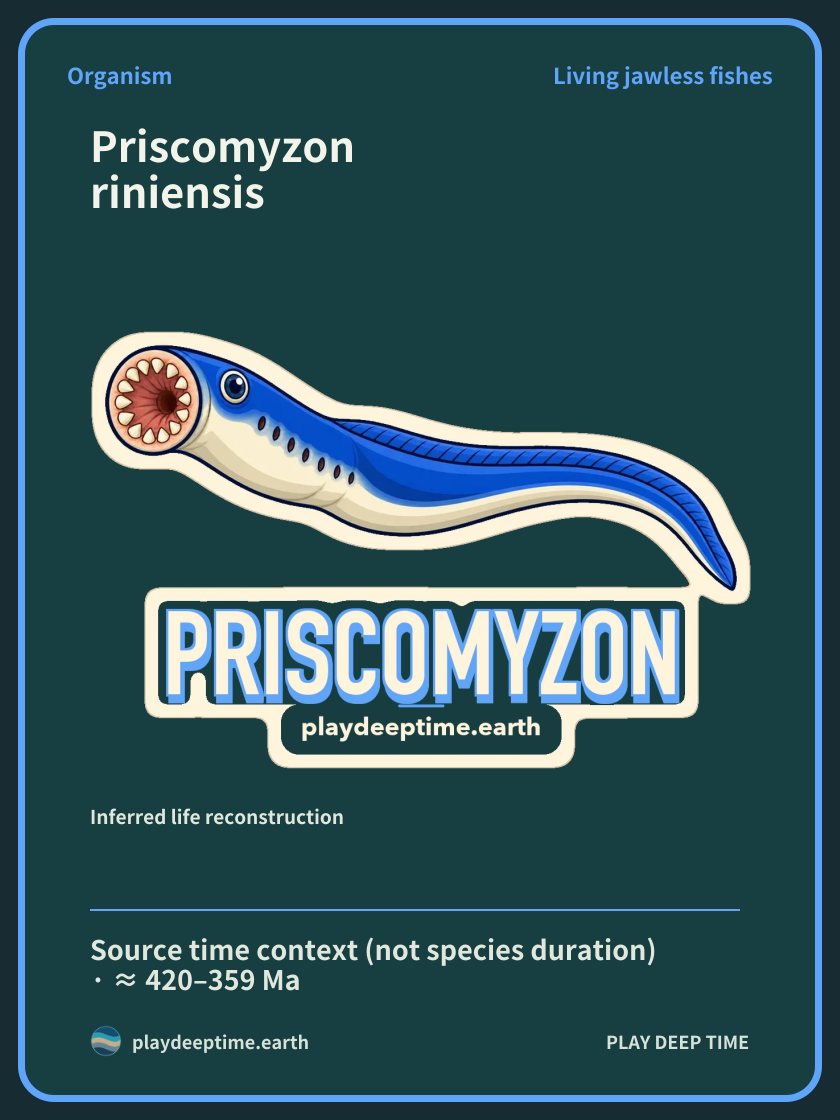
Priscomyzon riniensis was a Devonian lamprey relative. A round mouth, elongated body, and fin fold continuing toward the tail are known. Fossils of very young individuals changed ideas about ancient vertebrate forms.[1][2]
Loading illustration…
Key facts
Living lampreys differ greatly between their young and adult forms. Yet young Priscomyzon already show large eyes and a toothed oral structure. This prompted renewed questions about whether modern lamprey young directly represent a very ancient ancestor’s form.[2]
Time and place
It was a Late Devonian animal from around 360 million years ago. Fossils were discovered in present-day South Africa. Material from a region then belonging to Gondwana reveals the history of jawless vertebrates.[1][2]
The time range describes source context, not the complete duration of this species.
Size, form and skeleton
Adult specimen AM5750 was described as having 14 pointed cusps around the mouth. The trunk behind the gills is short and tapers backward. A fin fold extending from the back toward the tail is also known.[1]
Holotype AM5750 has a total length of 42 mm, about 4.2 cm. Mouth and gill structures are preserved together in this tiny fossil.[5]
Loading illustration…
Habitat and reproduction
Its early life is interpreted as differing from that of living lamprey larvae. Rather than a filter-feeding form like modern larvae, it had developed feeding structures with large eyes and tooth cusps. Comparing growth stages helps explore ancient lamprey feeding.[2]
Fossil discovery
A 2006 study reported an ancient lamprey fossil from South Africa. New research comparing young individuals with adults appeared in 2021. A region initially considered related to the ear was also reinterpreted as an eye.[1][2]
References
- Gess et al.2006 — A Devonian lamprey from South Africa
- Miyashita et al.2021 — Early life stages of Palaeozoic lampreys
- Gess et al.2006 — A Devonian lamprey from South Africa
- Chang, Zhang & Miao2006 A lamprey from the Cretaceous Jehol biota of China, Nature441:972–974
- Gess et al. (2006) — A lamprey from the Devonian of South Africa
Research questions
When is it valid to think that a living animal’s young reveal a very ancient ancestor’s form? Growth-stage fossils of Priscomyzon provided an opportunity to test that hypothesis directly. Studies of several Paleozoic lampreys have also renewed discussion of larval evolution.[2]
Observation
Look from the round mouth to the eyes and gill region, then follow the fold toward the tail. Consider which features persist from young individuals to adults.[1][2]
Related organisms
 Mesomyzon mengaeLiving jawless fishesSource time context (not species duration) · ≈ 143–66 Ma
Round mouths of lampreys from different times
Priscomyzon is known from Late Devonian material in present-day South Africa, and Mesomyzon from Early Cretaceous material in Inner Mongolia, China. Compare round mouths and elongated bodies in lampreys from widely separated times and localities. While finding similarities, also examine body regions known separately from each fossil.