Organism · Flowering plants
Pluricarpellatia peltata
Source time context (not species duration) · ≈ 143–66 Ma
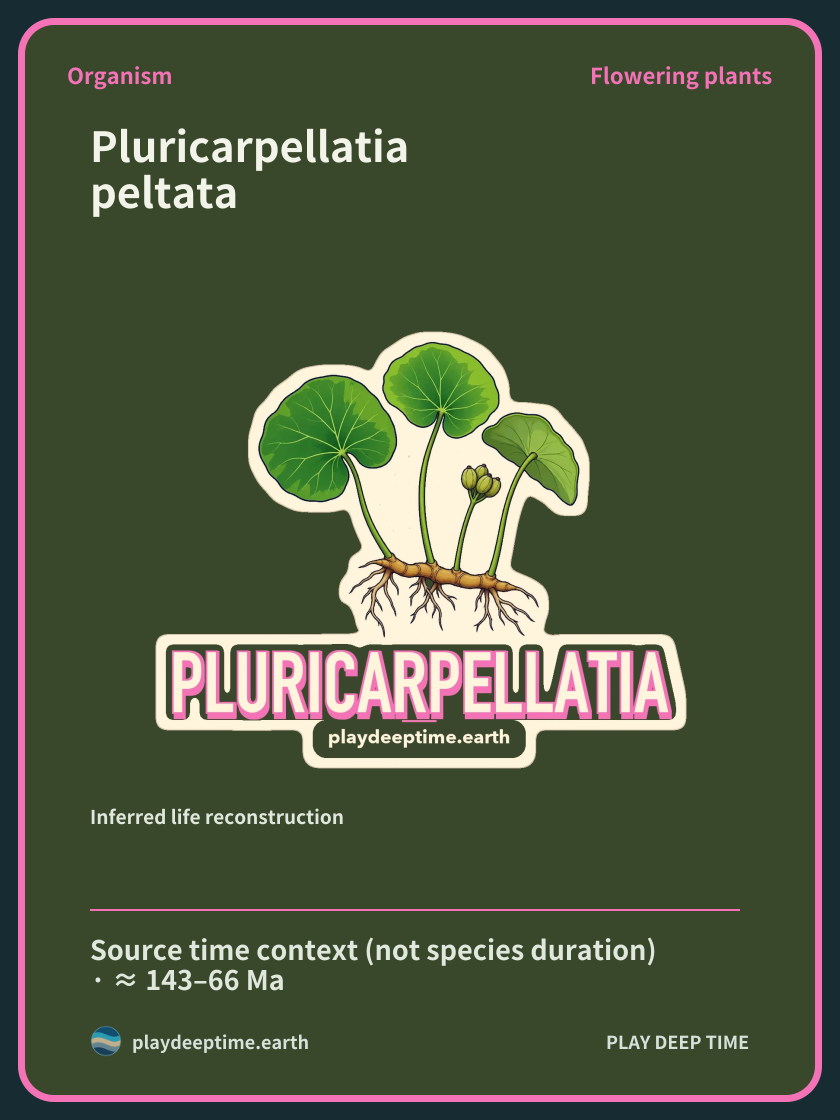
Inferred life reconstruction
Pluricarpellatia peltata
Overview
This small Cretaceous plant preserves leaves, roots, and seeds together. Pluricarpellatia peltata is an ancient flowering plant compared with living water-lily relatives, revealing the early diversity of angiosperms.[1]
Loading illustration…
Key facts
The petiole attaches at or off the center of a shield-like leaf. Attachment positions can vary even among leaves of the same plant. Seeds also remain within the reproductive structures, allowing leaf form and reproductive organs to be examined together.[1]
Time and place
The specimens came from the Early Cretaceous Crato Formation in present-day northeastern Brazil. This plant record reaches into the distant past when South America was part of Gondwana.[1]
The time range describes source context, not the complete duration of this species.
Size, form and skeleton
It is a soft-stemmed herb characterized by rhizomes, or underground stems, long petioles, and leaves ranging from heart-shaped to shield-shaped. Nearly complete specimens preserving several organs allow a much more three-dimensional picture of the plant than a single leaf would.[1]
Pluricarpellatia peltata is an aquatic plant preserving slender stems together with leaves. The originally reported plant extends more than 25cm across, with rounded leaves at the ends of long petioles.[8]
Loading illustration…
Habitat and reproduction
Seeds remaining in place within reproductive structures provide clues to understanding reproduction. Researchers compared seed attachment and carpel structure alongside leaves and rhizomes. The evolution of flowering plants can be read not only in showy petals but also in such small connections.[1]
Fossil discovery
It was introduced as a new genus and species in a 2008 study. Several specimens with roots, leaves, and seed-bearing reproductive structures together formed the basis of the research. These are valuable fossils because there is less need to assemble separately preserved organs artificially.[1]
References
- Pluricarpellatia, a nymphaealean angiosperm from the Lower Cretaceous of northern Gondwana (Crato Formation, Brazil)
- Pluricarpellatia, a nymphaealean angiosperm from the Lower Cretaceous of northern Gondwana (Crato Formation, Brazil)
- Heads et al. (2017) — A Cretaceous mushroom with preserved cap and gills
- International Commission on Stratigraphy (2024) — Geological time chart
- 2018 correction — The naming record of Gondwanagaricites
- Gomez et al. (2015) — Montsechia, an ancient aquatic angiosperm
- Pluricarpellatia, a nymphaealean angiosperm from the Lower Cretaceous of northern Gondwana (Crato Formation, Brazil)
- Mohr et al. (2008) — Pluricarpellatia, a Cretaceous aquatic plant
Research questions
Researchers proposed that it may belong to an early branch of Nymphaeales. It also resembles Cabombaceae, familiar today as aquarium plants, but differs in carpel structure. Those similarities and differences offer clues for asking how early water-lily relatives diversified.[1]
Observation
Examine not only the shapes of the broad leaves but also where the petioles attach and how several organs connect.[1]
Related organisms
 Gondwanagaricites magnificusFungiSource time context (not species duration) · ≈ 143–66 Ma
Plants and mushrooms preserved in the Crato Formation
The Crato Formation in present-day northeastern Brazil preserves Pluricarpellatia with leaves, roots, and seeds, and Gondwanagaricites with a cap, gills, and stalk. In the same Early Cretaceous formation, you can examine several plant organs alongside the small fruiting body of a mushroom.
 Montsechia vidaliiMontsechiaSource time context (not species duration) · ≈ 130–125 Ma
Different forms of Early Cretaceous flowering plants
Montsechia from present-day Spain and Pluricarpellatia from Brazil’s Crato Formation reveal different forms of Early Cretaceous angiosperms. Montsechia shows slender branches and small fruits, while Pluricarpellatia shows broad leaves, roots, and reproductive structures preserving seeds. Compare the early appearance of flowering plants through several organs.