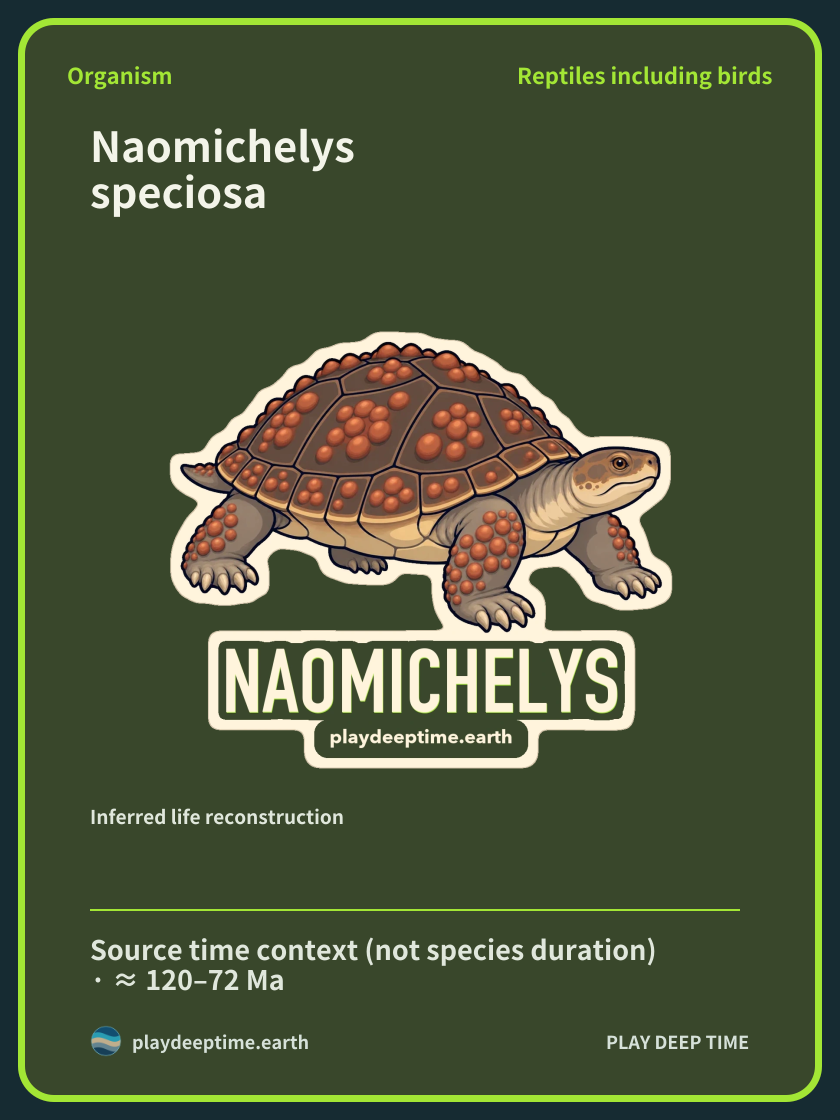
Organism · Reptiles including birds
Naomichelys speciosa
Source time context (not species duration) · ≈ 120–72 Ma
Inferred life reconstruction
Naomichelys speciosa
Overview
Naomichelys speciosa is a fossil turtle studied from material preserving the shell together with the skull and limbs. Tall projections have been reported on the shell and limb osteoderms. It offers a body unlike the first impression of a turtle with a smooth shell.[1]
Loading illustration…
Key facts
FMNH PR273, with its nearly complete shell, is not the same specimen as AMNH6136, the name-bearing type. The type specimen is part of a plastron bone. The fossil used to name an animal and the one revealing its body in detail may be different.[1]
Time and place
A 2014 study examined Early Cretaceous material from present-day Texas, United States. Fossil-bearing layers grouped under this species in the fossil database are summarized as spanning approximately 120–72 million years ago. The particular Texas skeleton can be considered alongside records from several fossil layers.[1][2]
The time range describes source context, not the complete duration of this species.
Size, form and skeleton
FMNH PR273 includes a nearly complete shell along with evidence of the skull, limbs, and body axis. Tall projections on the shell and limb osteoderms are also described. It allows the surface of the hard shell to be considered separately from the body extending beyond it.[1]
Naomichelys speciosa was a large turtle even judging by the shell alone. Specimen PR273 from Texas has a carapace length of 72.5 cm measured along the midline. A straight-line measurement including the projecting outer margins gives 80 cm, so the length varies with the measurement position.[3]
Loading illustration…
Habitat and reproduction
A turtle’s body is not confined within its carapace. Material from this specimen allows the shell, head, and limbs to be compared together. Examining limb osteoderms alongside the shell surface reveals differences in the structures covering the body.[1]
Fossil discovery
Joyce and colleagues’ 2014 study examined the anatomy of the Texas skeleton in detail. They compared the small plastron bone of the type specimen with separate associated material to examine the basis for assigning them the same name. The story expands from a single fragment to a skeleton preserving many more regions.[1]
References
Research questions
Is the reference for a species name necessarily its most complete fossil? Naomichelys invites us to distinguish the small bone of the type specimen from richer material studied later. A specimen’s role and its preserved body regions provide different kinds of information.[1]
Observation
After examining the raised features on the shell surface, move your gaze to the head and limbs. Comparing limb osteoderms with the shell reveals this turtle’s distinctive exterior.[1]
Related organisms
 Toxochelys latiremisTurtle lineageSource time context (not species duration) · ≈ 143–66 Ma
Different bodies among turtles
Compare the bodies of Naomichelys speciosa and Toxochelys latiremis. Naomichelys speciosa: a fossil turtle studied from material preserving the shell together with the skull and limbs. Toxochelys latiremis: a turtle that swam through Cretaceous seas.