Organism · Lungfishes
Neoceratodus forsteri
Present
Living species illustration
Neoceratodus forsteri
Overview
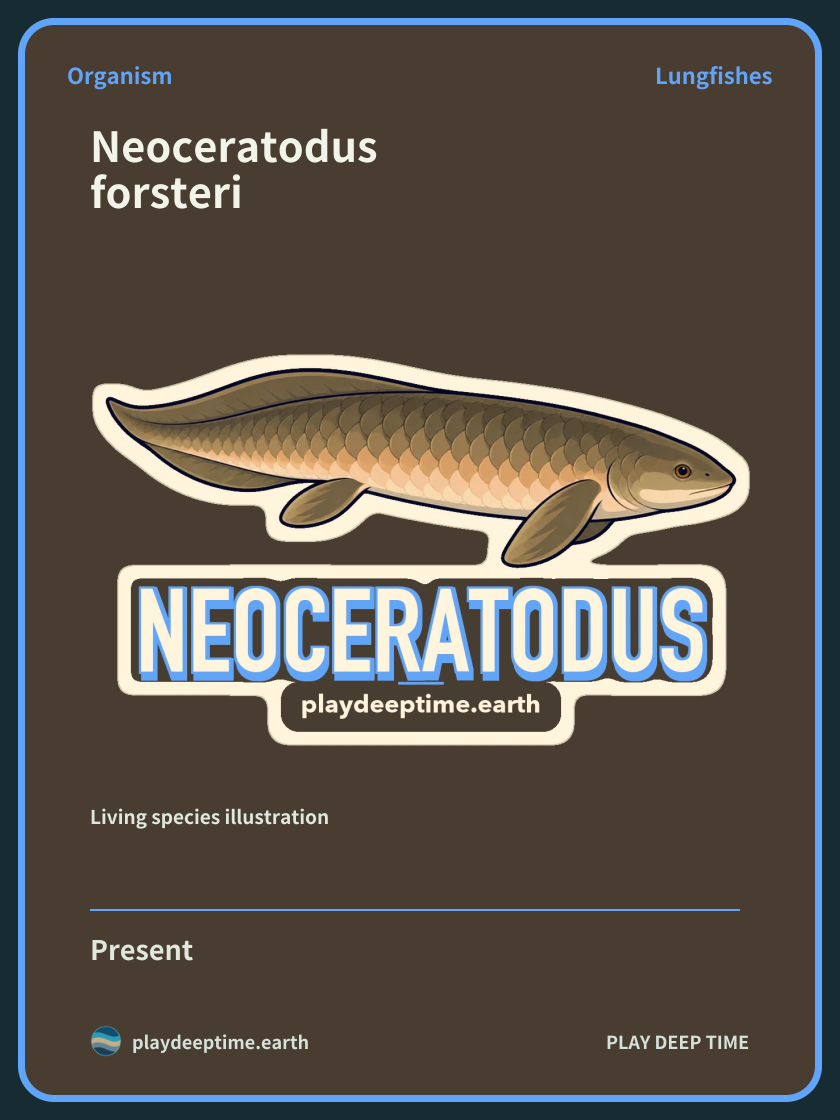
The Australian lungfish, Neoceratodus forsteri, is a fish with both gills and a lung. Large overlapping scales and fleshy, paddle-shaped fins are conspicuous. Its aquatic body and air-breathing respiration can be examined together.[1]
Loading illustration…
Key facts
What sound does it make when it surfaces to exchange air in its lung? The museum likens it to air emerging from a small bellows. Alongside its visibly large fins, its breathing is a special feature.[1]
Time and place
It lives today in freshwater in Queensland, Australia. The Burnett and Mary river systems are important parts of its distribution, and records of transfers to other nearby drainage systems are also introduced. It usually uses deep pools or slow-flowing river sections.[1]
The time range describes source context, not the complete duration of this species.
Size, form and skeleton
It has a broad, flattened head, a thick body, and large overlapping scales. The pectoral fins resemble fleshy paddles, while the dorsal, caudal, and anal fins at the rear of the body are continuous. The institution reports a maximum length of about 1.8m.[2]
Loading illustration…
Habitat and reproduction
It usually breathes mainly through its gills, but also takes air at the surface when water conditions change. Its food is described as including crustaceans, insect larvae, mollusks, and small fishes.[1][2]
The institutional account describes reproduction by laying eggs among aquatic plants and roots near the water’s edge. Small spaces where water and plants meet connect with new life in a large fish.[1][2]
Fossil discovery
In the nineteenth century it was also known as the Burnett salmon. Museum director Krefft recognized a lung in a specimen received from his friend William Forster and introduced it scientifically in 1870. The species name forsteri commemorates his friend.[1]
References
Research questions
How do fleshy fins, a lung, and gills work together in one body? External form, breathing, food, and spawning sites can be examined side by side. Features of an ancient fish group can be studied in an animal alive today.[1][2]
Observation
Move your gaze from the large overlapping scales to the paddle-like pectoral fins. Viewing the continuous fin outline at the rear together with the broad, flattened head reveals differences from other fishes.[2]
Related organisms
 Euphanerops longaevusVertebratesSource time context (not species duration) · ≈ 420–359 Ma
Different fish bodies and times
Explore the bodies and living backgrounds of the Australian lungfish and Euphanerops together. Australian lungfish: The Australian lungfish, Neoceratodus forsteri, is a fish with both gills and a lung. Large overlapping scales and fleshy, paddle-shaped fins are conspicuous. Euphanerops: Euphanerops is a Late Devonian fish known for an elongated body and long dorsal fin. A nearly complete adult and separate juvenile material have been studied. Australian lungfish: It lives today in freshwater in Queensland, Australia. The Burnett and Mary river systems are important parts of its distribution, and records of transfers to other nearby drainage systems are also introduced. Euphanerops: It is known from research addressing Late Devonian fish material. The Devonian as a whole was roughly 420–360 million years ago.