Organism · Turtle lineage
Ocepechelon bouyai
Source time context (not species duration) · ≈ 143–66 Ma
Inferred life reconstruction
Ocepechelon bouyai
Overview
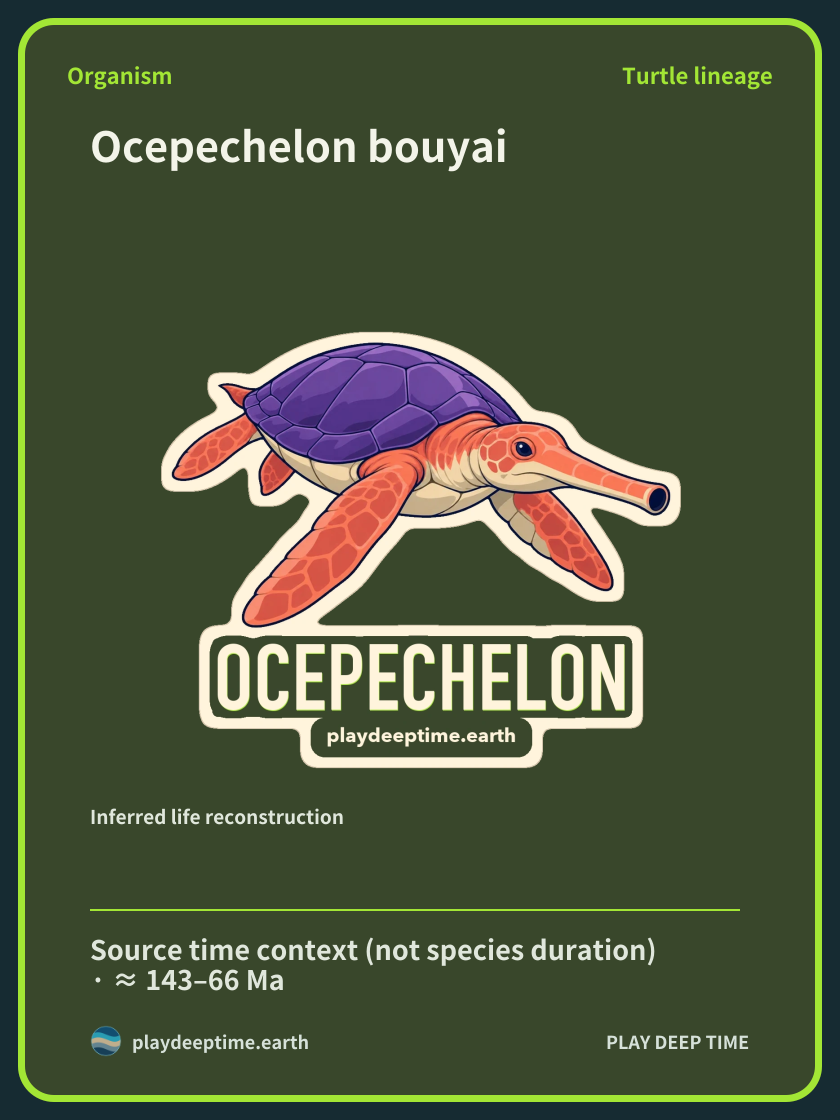
How would a turtle feed if its mouth looked like an elongated straw? Ocepechelon bouyai was a turtle of the latest Cretaceous seas, with a striking tube-like snout and a round, forward-facing mouth.[1]
Loading illustration…
Key facts
Researchers interpreted this unusual mouth as a device for sucking in prey along with water. Intriguingly, similar feeding strategies occur in pipefishes, relatives of seahorses, and in some whales. Distant relatives can develop structures that solve similar problems.[1]
Time and place
Its setting was the sea of the late Maastrichtian, near the very end of the Cretaceous. The fossil was discovered in phosphate beds at Sidi Chennane in the Ouled Abdoun Basin of present-day Morocco. Modern place names help locate where it was found.[1]
The time range describes source context, not the complete duration of this species.
Size, form and skeleton
The type specimen’s skull alone measures 70 cm long and 43 cm wide. The contrast between its long, slender front and broadly expanded rear is pronounced. These numbers describe the head, so it is useful to focus first on snout-to-head proportions in the illustration.[1]
Loading illustration…
Habitat and reproduction
It has been proposed that this turtle sought food near the sea surface. Researchers drew this interpretation from the eyes and nostrils high on its head, its streamlined head shape, and marine sediments. Its distinctive mouth adds variety to feeding strategies in Cretaceous seas.[1]
Fossil discovery
The specimen that introduced this animal to science was the isolated, complete skull OCP DEK/GE 516. In 2013, researchers described a new genus and species based on the skull’s unfamiliar structures.[1]
References
- Bardet, N. et al. (2013). “A Giant Chelonioid Turtle from the Late Cretaceous of Morocco with a Suction Feeding Apparatus Unique among Tetrapods.” PLOS ONE 8(7): e63586. DOI: 10.1371/journal.pone.0063586.
- Bardet, N. et al. (2013). “A Giant Chelonioid Turtle from the Late Cretaceous of Morocco with a Suction Feeding Apparatus Unique among Tetrapods.” PLOS ONE 8(7): e63586. DOI: 10.1371/journal.pone.0063586.
- Gheerbrant et al.2005 — The skull and teeth of the early proboscidean Phosphatherium
- Gheerbrant et al.2005 — New material of Phosphatherium and proboscidean evolution
Research questions
The lower jaw and hyoid apparatus of the neck are not yet known. Discovering them could reveal more clearly how the suction-feeding mechanism worked and what size prey it consumed.[1]
Observation
Focus on the contrast between the tube-like elongated snout and the broad head.[1]
Related organisms
 Phosphatherium escuillieiPlacental mammalsSource time context (not species duration) · ≈ 56–33.9 Ma
Different times recorded in one phosphate basin
Ocepechelon and Phosphatherium are known from different times and areas within the Ouled Abdoun Basin in present-day Morocco. Connect the tube-like snout of a latest Cretaceous sea turtle with the head and teeth of an early Eocene elephant relative to explore records of different ages preserved in one basin.