Organism · Reptiles including birds
Proganochelys quenstedtii
Source time context (not species duration) · ≈ 252–201 Ma
Inferred life reconstruction
Proganochelys quenstedtii
Overview
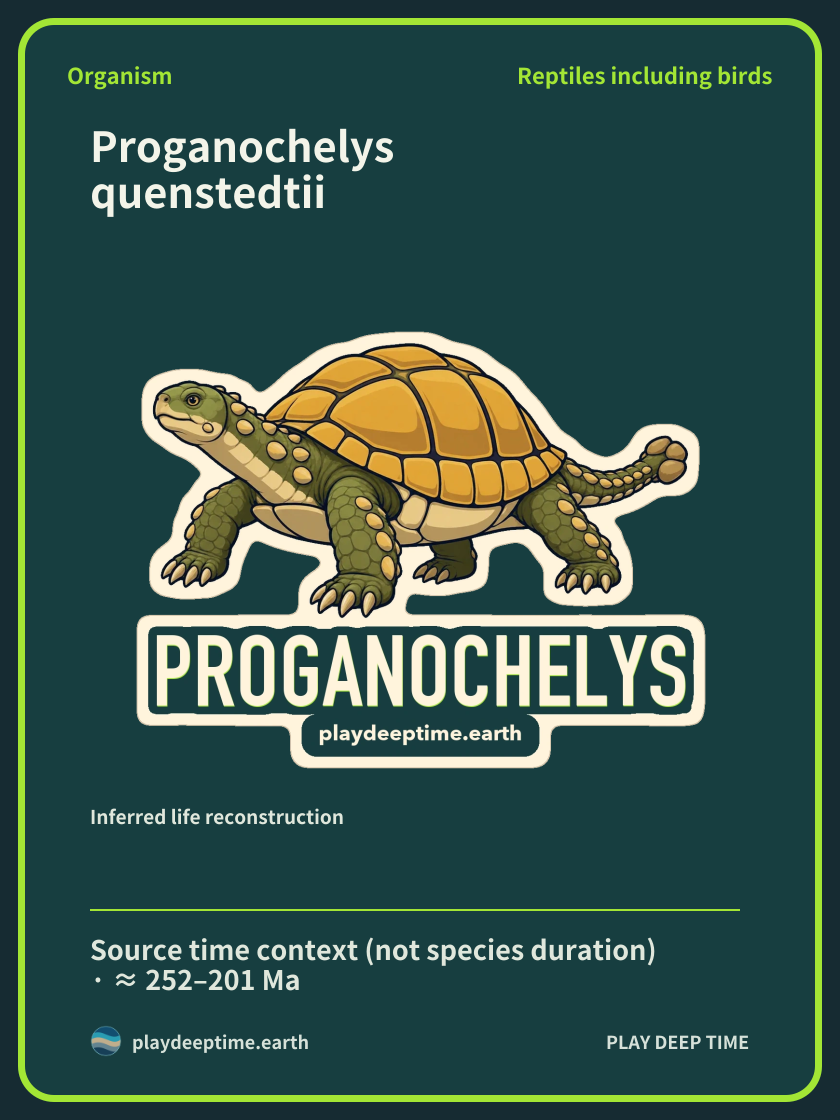
Proganochelys quenstedtii is an early turtle known to have a complete carapace and plastron. Bony skin plates are also described on its neck, limbs, and tail. Its large shell can be explored alongside several other rigid structures.[1]
Loading illustration…
Key facts
The carapace and plastron connect through bony bridges on either side. Bony structures gather into a club-like form at the tail tip. Different arrangements appear at the center and rear end of the body.[1]
Time and place
It is presented through Late Triassic Norian material from present-day Germany. The entire Triassic spanned approximately 250–200 million years ago. It has been compared in studies of early turtle shells and ecology.[3][4]
The time range describes source context, not the complete duration of this species.
Size, form and skeleton
The upper and lower shells connect along both sides. The neck, limbs, and tail bear bony skin plates, and the tail tip forms a club-like structure. Five digits on the hands and feet and their internal bone arrangements are also described in the literature.[1]
The straight midline length of the carapace of specimen SMF09-F2 from Frick, Switzerland, was reported as 51.9 cm.[9]
Loading illustration…
Habitat and reproduction
Where did an early turtle with a rigid shell live? Studies of internal cranial anatomy, senses, and ecology have offered interpretations supporting a terrestrial lifestyle. The inside of the head, as well as the shell, provides clues to questions about its life.[2]
Fossil discovery
A review of early turtle body form discussed the shell and bony skin plates of Proganochelys. Studies of sensory biology and ecology in 2018 and shell evolution in 2019 also compared this animal. Different questions about early turtles emerge from several regions of the body.[1][2][3]
References
- Schoch·Sues (2020) — Origin of the turtle body plan
- Lautenschlager et al. (2018) — Senses and ecology of early turtles
- Szczygielski·Sulej (2019) — Evolution of the early turtle shell
- International Commission on Stratigraphy (2024) — Geological time chart
- Pedernera et al. (2019) — Volcanic activity and plant fossils of the Agua de la Zorra Formation
- Schoch·Sues (2020) — Origin of the turtle body plan
- Szczygielski·Sulej (2019) — Evolution of the early turtle shell
- International Commission on Stratigraphy (2024) — Geological time chart
- Study of Proganochelys quenstedtii found at Frick, Switzerland
Research questions
Where do the carapace and plastron join? Examining the bony bridges on either side helps explain the connection between these two large shells. This is a way of reading a rigid outline as a combination of several plates.[1]
Observation
First examine the side connections between the carapace and plastron. Moving your gaze from the bony plates of the neck and limbs to the club-like tail tip reveals features beyond the large shell.[1]
Related organisms
 Johnstonia coriaceaVascular plantsFossil record age bounds · ≈ 237–201 Ma
Late Triassic plants and early turtles
Read the leaves of Johnstonia alongside the rigid body of Proganochelys. Different Late Triassic material from present-day Argentina and Germany tells distinct stories about plants and early turtles.