Organism · Dinosaurs
Protoceratops andrewsi
Source time context (not species duration) · ≈ 143–66 Ma
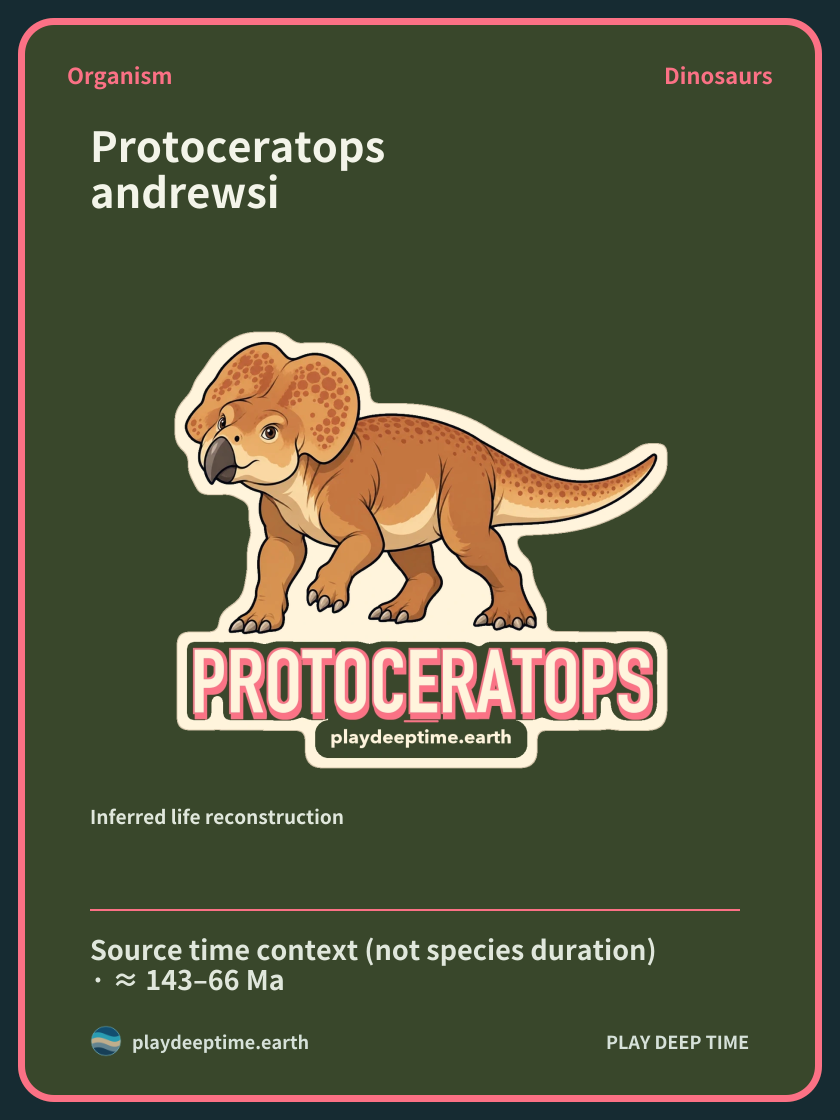
Inferred life reconstruction
Protoceratops andrewsi
Overview
Protoceratops andrewsi is a dinosaur distinguished by a low nasal projection and a bony neck frill rather than large horns. It processed plant food with a horny beak at the front of its head. The broad structure behind the head can be examined alongside a sturdy, four-legged body.[1][3]
Loading illustration…
Key facts
The neck frill changed during growth. Placing juvenile and larger skulls side by side reveals differences in frill size and outline. When several bodies of the same species are preserved, researchers can investigate a growing dinosaur.[1][3]
Time and place
This dinosaur is known from the Late Cretaceous of present-day Mongolia. The Late Cretaceous spans roughly 100–66 million years ago. Its body can be compared with those of other dinosaurs from the region as a small relative of horned dinosaurs.[2][5]
The time range describes source context, not the complete duration of this species.
Size, form and skeleton
The head has a neck frill, a low nasal projection, and thick bone above the eyes. Four sturdy legs support the body. An institutional species account gives a body length of roughly 1–2 m.[1][2][3]
Loading illustration…
Habitat and reproduction
It is described as having a plant-cutting horny beak and a sturdy quadrupedal body. Comparing small juvenile heads with developed frills helps explore how feeding structures and body supports changed during growth.[3][1]
Fossil discovery
Museums describe juvenile Protoceratops fossils and adult body forms separately. A 2019 study of the limb skeleton compared forelimbs, hind limbs, hands, and feet in greater detail. Research extends beyond the striking head to the structures that supported the body.[3][4]
References
- Carnegie Museum — The skull and frill of Protoceratops
- Protoceratops andrewsi
- American Museum of Natural History — A young Protoceratops
- Słowiak et al. (2019) — The limb skeleton of Protoceratops
- International Commission on Stratigraphy (2024) — Geological time chart
- AMNH — Two dinosaurs locked together as fossils
Research questions
How did frill proportions change relative to the rest of the body during growth? Researchers compare skulls and postcranial bones of different sizes. Differences among individuals offer clues to a dinosaur’s lifetime.[1][3]
Observation
Move your gaze from the horny beak to the low nasal projection, thick bone above the eyes, and neck frill. Then examine how the neck beneath the frill connects with the four-legged body.[1]
Related organisms
 Velociraptor mongoliensisDinosaursSource time context (not species duration) · ≈ 143–66 Ma
A Cretaceous moment with claw and beak locked together
A Late Cretaceous fossil discovered in present-day Mongolia preserves two dinosaurs in a close-combat posture. The hind-foot claw of Velociraptor lies near the neck of Protoceratops, while the beak of Protoceratops rests on its opponent’s arm. Read bodily weapons alongside their opposing postures to examine a moment of struggle preserved in the fossil.