Organism · Jawed vertebrates
Pterichthyodes milleri
Fossil record age bounds · ≈ 393–388 Ma
Inferred life reconstruction
Pterichthyodes milleri
Overview
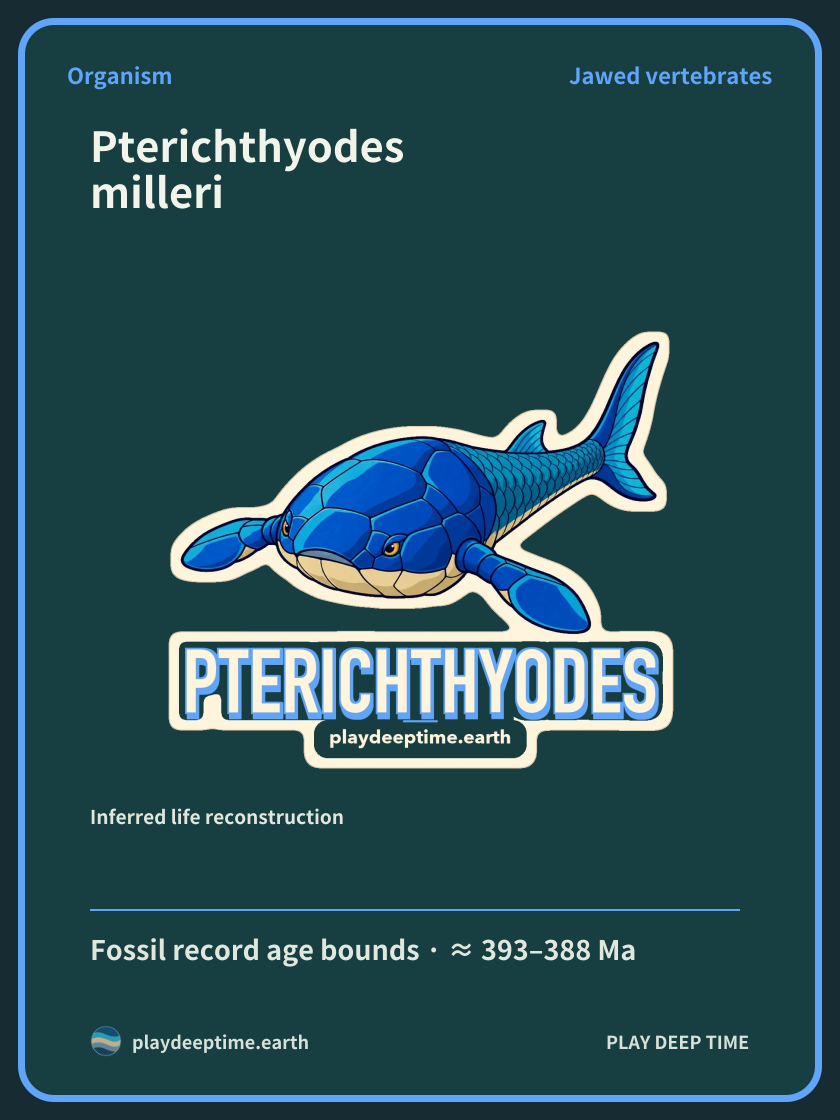
Pterichthyodes milleri is a fish whose front body is enclosed in armor. Pectoral appendages projecting from either side resemble small paddles or wings. Follow the transition from the rigid front body to the scale-covered rear body and tail.[1]
Loading illustration…
Key facts
A commentary title calls this fish “winged Pterichthys.” The striking wing-like parts are articulated appendages attached to the chest. Forms with broad and narrow ends are known, allowing different silhouettes to be compared within the same fish.[1]
Time and place
The photograph caption in the source collection presents this fish as a Middle Devonian species. Trewin’s commentary includes specimens from Achanarras Quarry in Caithness, present-day Scotland, United Kingdom. Fossils left in an ancient lake can be explored alongside their locality.[2][1]
The time range describes source context, not the complete duration of this species.
Size, form and skeleton
The armor of the front body is flat below and highly arched above. Paddle-like pectoral appendages articulate with the trunk. The rear body is reconstructed with scales and a small dorsal fin, ending in a tail whose upper and lower portions differ in shape.[1]
The total body length of Pterichthyodes is reconstructed as approximately 25 cm. This estimated length includes the tail extending behind the rigid armor of the head and trunk.[10]
Loading illustration…
Habitat and reproduction
Juveniles and adults are both known from the Achanarras Fish Bed. Trewin interpreted this size distribution as evidence supporting the possibility that the fish used the same lake throughout life. This explores lifestyle through the record of several individuals as well as the form of a single fossil.[1]
Fossil discovery
Agassiz examined fossils including Hugh Miller’s collection and distinguished several species based on differences in body and pectoral-appendage shape. A 2003 commentary introduces research comparing more specimens and explains that those differences were treated as variation within Pterichthyodes milleri. As collections grew, interpretations of the names changed.[1]
References
- Trewin (2003) — The story of an armoured fish that looked winged
- Photograph caption in a collected volume — Middle Devonian Pterichthyodes
- Trewin (2003) — The story of an armoured fish that looked winged
- Photograph caption in a collected volume — Middle Devonian Pterichthyodes
- Dineley (1999) — Fossil fishes from the Middle Devonian of Scotland
- Natural History Museum, London — Coccosteus specimen record
- International Commission on Stratigraphy (2024) — Geological time chart
- Engelman (2024) — Comparing body reconstructions of Coccosteus
- Achanarras Quarry SSSI — Site Management Statement
- Sallan·Galimberti (2015) — Changes in vertebrate size before and after the end-Devonian extinction
Research questions
After a dead fish sank to the lake floor, the upper armor of the front body could loosen and collapse, with the head falling to one side. Trewin explained these preservation processes. Considering scattered plate positions alongside the organization of the living body makes reconstructing the original form from fossils more engaging.[1]
Observation
The illustration joins the body regions based on the reconstruction in Trewin’s commentary, which follows Hemmings’s 1978 reconstruction. Examine the arched front body, lateral pectoral appendages, scaly rear body, and tail in sequence. Fine plate boundaries, body proportions, and coloration are interpretations used to portray the whole animal.[1]
Related organisms
 Coccosteus cuspidatusJawed vertebratesSource time context (not species duration) · ≈ 420–359 Ma
Two armored fishes of Achanarras
Pterichthyodes milleri and Coccosteus cuspidatus both appear in lists of fossil fishes from Middle Devonian Achanarras. This quarry in present-day Scotland, United Kingdom, preserves the record of an ancient lake. After examining the rigid front bodies of both fishes, move your gaze to the paddle-like pectoral appendages of Pterichthyodes.