Organism · Seed plants
Ptilophyllum cutchense
Fossil record age bounds · ≈ 201–110 Ma
Inferred life reconstruction
Ptilophyllum cutchense
Overview
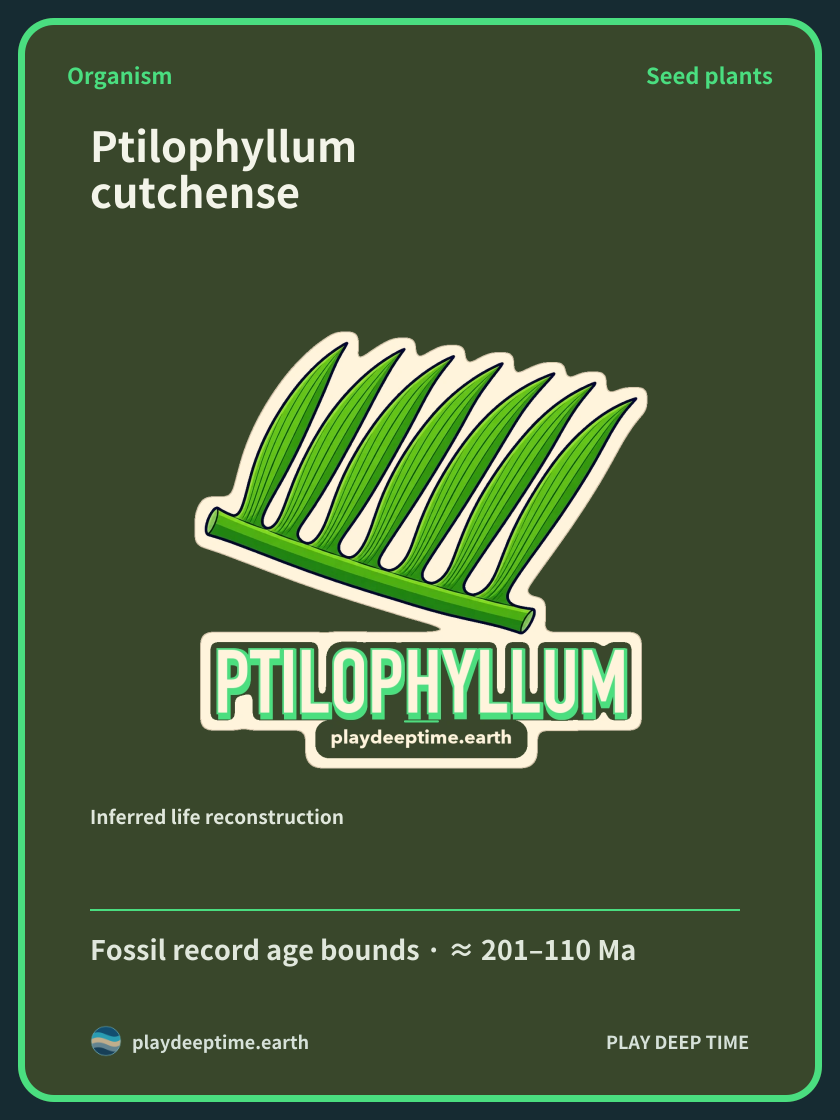
Ptilophyllum cutchense is a fossil plant known from pinnate foliage. Its form can be explored by following the central axis, lateral pinnae, and their parallel veins.[1]
Loading illustration…
Key facts
The pinnae attach obliquely by their entire bases to the upper surface of the axis. Examining both the margins and attachment of the slender, elongated pinnae is an important observation in the description.[1]
Time and place
It appears in research on the Gangapur Formation and is associated with the plant world of the Early Cretaceous. The locality examined in this study is in present-day Telangana, India.[1]
The time range describes source context, not the complete duration of this species.
Size, form and skeleton
The pinnae have smooth margins, and veins originating at their bases run parallel. The veins are described as mostly unbranched, though rarely forking once.[1]
Ptilophyllum cutchense has narrow, elongated leaves bearing closely spaced small pinnae. A 2009 study of two leaf fossils from Western Australia recorded a preserved length of approximately 6.5 cm for the larger specimen. The leaf is incomplete, so its original length would have been greater.[4]
Loading illustration…
Habitat and reproduction
The Gangapur Formation study treats several gymnosperm fossils. Examining different leaf records separately allows exploration of the diversity of ancient plants preserved in the same strata.[1]
Fossil discovery
The research material includes specimen numbers BSIP 40229–40232. Following those numbers allows leaves described as this species to be distinguished from differently named leaves for comparison.[1]
References
Research questions
Not all leaves on the same plate belong to the same species. The publication distinguishes several Ptilophyllum species and provisional comparative material by separate specimen numbers. Comparing leaf attachment and venation forms part of identifying their names.[1]
Observation
First look where the central axis and pinnae meet. Follow the smooth margins, then examine the parallel veins inside to observe both leaf outline and venation.[1]
Related organisms
 Dictyozamites indicusSeed plantsFossil record age bounds · ≈ 162–143 Ma
Different leaves from Early Cretaceous India
Compare Early Cretaceous plant records from India through their venation. The parallel veins of Ptilophyllum and the net-like veins of Dictyozamites provide different clues to recognizing leaves. The two records come from separate localities in present-day Telangana and Andhra Pradesh, India.