Organism · Archosaurs
Rhamphorhynchus muensteri
Source time context (not species duration) · ≈ 201–143 Ma
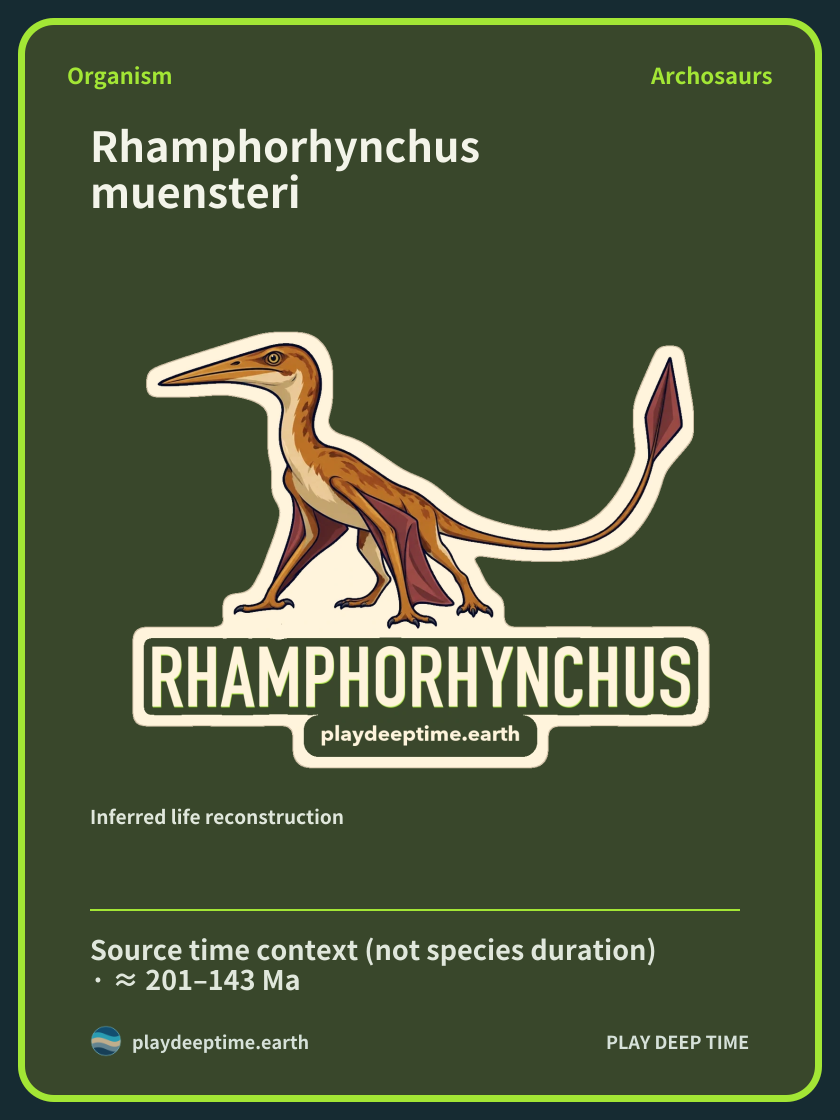
Inferred life reconstruction
Rhamphorhynchus muensteri
Overview
Rhamphorhynchus muensteri was a pterosaur with a long tail ending in a vertical membrane. An elongated finger supported the large wing membrane. Including the tail and long teeth reveals an unfamiliar body of Late Jurassic skies.[1][2]
Loading illustration…
Key facts
Even the soft tail membrane contained supporting structures. Research introduced in 2024 described its fiber network as limiting excessive stretching. Small fibers within a thin membrane became important clues to the body.[2]
Time and place
It is known from the Late Jurassic, around 150 million years ago, in the Solnhofen region of present-day Germany. The locality is also famous for Archaeopteryx and several crustacean fossils. Diverse fossils from the same region can be examined together.[1]
The time range describes source context, not the complete duration of this species.
Size, form and skeleton
An elongated wing finger, long tail, and membrane at the tail tip are characteristic. Long teeth are described at the front of the mouth and shorter teeth behind. A museum gives the distance between the wing tips of a large specimen as about 1.8 m.[1][3]
Loading illustration…
Habitat and reproduction
It was a flying reptile with wing and tail membranes. Considering long teeth, wings, and tail together raises questions about feeding and flight. Tail membrane structure is also studied in relation to controlling the body in the air.[1][2]
Fossil discovery
Solnhofen fossils offered opportunities to study soft wing and tail structures alongside bones. Tail membrane research in 2024 and a large-specimen study in 2025 continued this work. Material from an old fossil locality remains connected to new anatomical and comparative studies.[1][2][3]
References
- Pterosaurs: The truth about these flying dinosaurs
- Chinese University of Hong Kong2024 — A fiber network in the tail membrane of Rhamphorhynchus
- Hone & McDavid2025 — A large Rhamphorhynchus specimen
- Natural History Museum — Fossil bird collections
- Albrecht (1983) — Die Protastacidae n. fam., fossile Vorfahren der Flusskrebse?
- Natural History Museum — Pterosaurs and Rhamphorhynchus
Research questions
What role did the tail-tip membrane play in flight? Researchers compare fiber arrangements and membrane shape to investigate possible functions. Considering the supporting wing finger and tail together broadens understanding of pterosaur flight structures.[2][1]
Observation
Move your gaze from the teeth to the elongated wing-supporting finger, then to the membrane at the end of the long tail. Different structures at the front, sides, and rear of the body come into view.[1][3]
Related organisms
 Archaeopteryx lithographicaBirds and early avialansSource time context (not species duration) · ≈ 201–143 Ma
A pterosaur and bird of Solnhofen
Rhamphorhynchus and Archaeopteryx are known from Late Jurassic fossils in the Solnhofen region of present-day Germany. Compare a membranous pterosaur wing with a feathered bird wing.
 Pseudastacus pustulosusArthropodsSource time context (not species duration) · ≈ 201–143 Ma
Different fossils of Solnhofen
Pseudastacus and Rhamphorhynchus are known from Jurassic fossils in the Solnhofen region of present-day Germany. Examining a crustacean and a pterosaur together reveals the diversity preserved at this locality.