Organism · Coelacanths
Rieppelia heinzfurreri
Fossil record age bounds · ≈ 243–241 Ma
Inferred life reconstruction
Rieppelia heinzfurreri
Overview
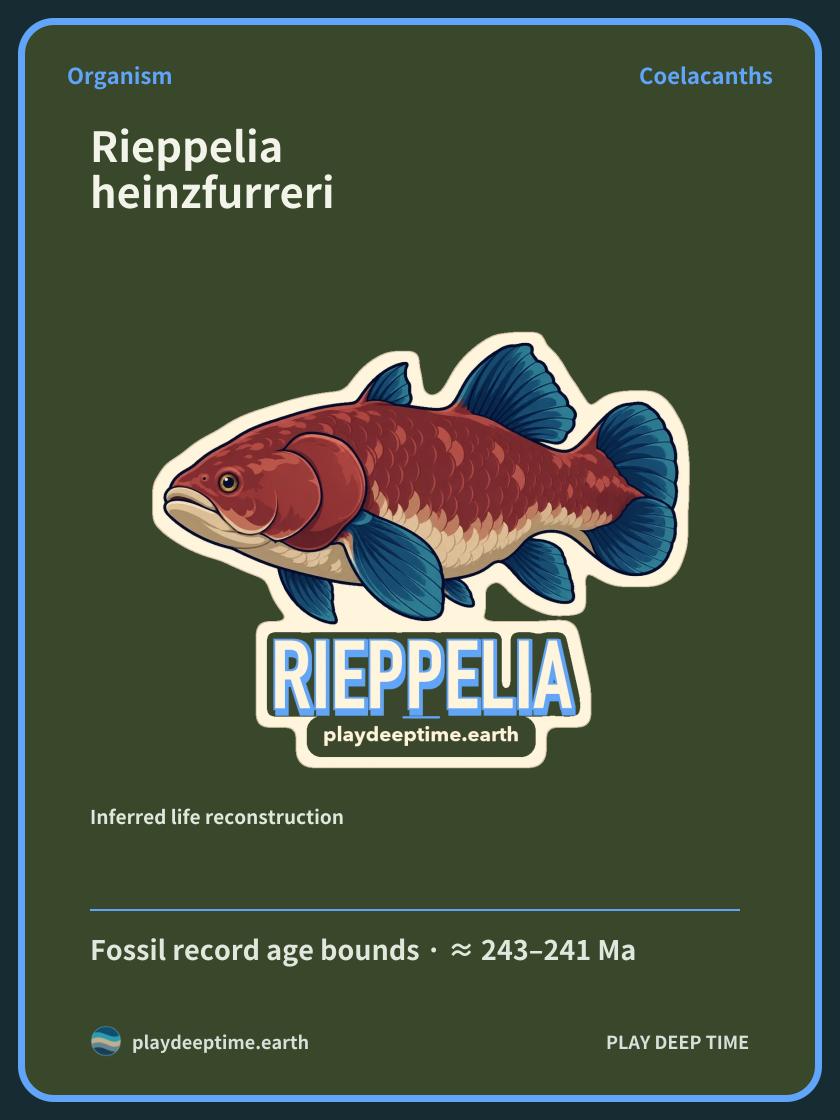
Rieppelia heinzfurreri is a Middle Triassic coelacanth with a short, plump body. A large gill cover and well-developed fins create a distinctive silhouette. Even ancient coelacanths included unfamiliar body arrangements like this.[1]
Loading illustration…
Key facts
The genus name Rieppelia honors Olivier Rieppel, who first reported the existence of this fish. The species name heinzfurreri commemorates Heinz Furrer’s contributions to research on Monte San Giorgio and the Swiss Triassic. One name contains the work of two researchers.[1]
Time and place
The fossil is known from the Besano Formation at Monte San Giorgio. The locality spans present-day Ticino, Switzerland, and the Varese area of Italy. The paper describes the fossil-bearing strata as late Anisian of the Middle Triassic. Modern place names guide us to records of an ancient sea.[1]
The time range describes source context, not the complete duration of this species.
Size, form and skeleton
A large bony gill cover, small lower jaw, and short trunk are characteristic. The pectoral fins and rear dorsal fin are relatively large, while the outer tail outline is rounded. The type specimen PIMUZ T5902 was presented as 300 mm in total length.[1]
Loading illustration…
Habitat and reproduction
The Besano Formation and the comparative Prosanto Formation were described as deposits of shallow lagoons or basins at the western end of the Paleo-Tethys. Researchers interpreted restricted connections with the open sea as potentially favoring diversification of distinctive fish groups. The study explores unusual body form alongside ancient marine geography.[1]
Fossil discovery
The University of Zurich’s paleontological museum held material from mid-twentieth-century excavations at Monte San Giorgio. Some was studied in the 1980s, and in 2023 Ferrante and Cavin reexamined it to describe Rieppelia as a new genus and species. Old museum fossils became the focus of a new discovery.[1]
References
- Early Mesozoic burst of morphological disparity in the slow-evolving coelacanth fish lineage
- Ferrante·Cavin (2023) — A new view of a short, plump coelacanth
- Study — Trunk and fins of Besanosaurus
- International Commission on Stratigraphy (2024) — Geological time chart
- Postcranial anatomy of Besanosaurus leptorhynchus from the Middle Triassic Besano Formation of Monte San Giorgio
- The research history of the Middle Triassic fishes of Monte San Giorgio: getting out of the shadow of aquatic reptiles
- Ferrante·Cavin (2023) — A new view of a short, plump coelacanth
- Nosotti (2007) — Tanystropheus anatomy in small specimens from Besano
- University of Zurich (2020) — Long-necked Tanystropheus of different sizes
- International Commission on Stratigraphy (2024) — Geological time chart
- The research history of the Middle Triassic fishes of Monte San Giorgio: getting out of the shadow of aquatic reptiles
Research questions
The researchers compared how several body regions differed from the usual coelacanth arrangement. They examined connected changes such as a large gill cover and fins and a short trunk, suggesting that these differences might relate to changes in developmental regulation. Unfamiliar fossil form leads to questions about body evolution.[1]
Observation
The illustration is a still interpretation centered on the type specimen’s structure and the paper’s whole-skeleton and outline reconstructions. Move your gaze from the short trunk to the large gill cover and fins, then the rounded tail. Color, three-dimensional body thickness, and soft-tissue appearance are interpretations intended to make the fossil skeleton easier to read.[1]
Related organisms
 Besanosaurus leptorhynchusReptiles including birdsSource time context (not species duration) · ≈ 252–201 Ma
A short fish and a long ichthyosaur from Monte San Giorgio
The Middle Triassic Besano Formation of Monte San Giorgio preserves records of fishes and marine reptiles together. View Rieppelia heinzfurreri, with its short trunk and large gill cover, alongside Besanosaurus leptorhynchus, with its long snout, one pair of forefins, and one pair of hind fins. Different body arrangements can be encountered at a locality spanning present-day Switzerland and Italy.
 Tanystropheus longobardicusReptiles including birdsSource time context (not species duration) · ≈ 252–201 Ma
A short trunk and a long neck from the Besano area
Compare the short trunk of Rieppelia heinzfurreri with the long neck preserved in the small form of Tanystropheus longobardicus. Both records connect to the Middle Triassic Monte San Giorgio–Besano area, where present-day Switzerland and Italy meet. They reveal different body proportions in a fish and a reptile.