Organism · Mammals
Sinobaatar lingyuanensis
Source time context (not species duration) · ≈ 143–66 Ma
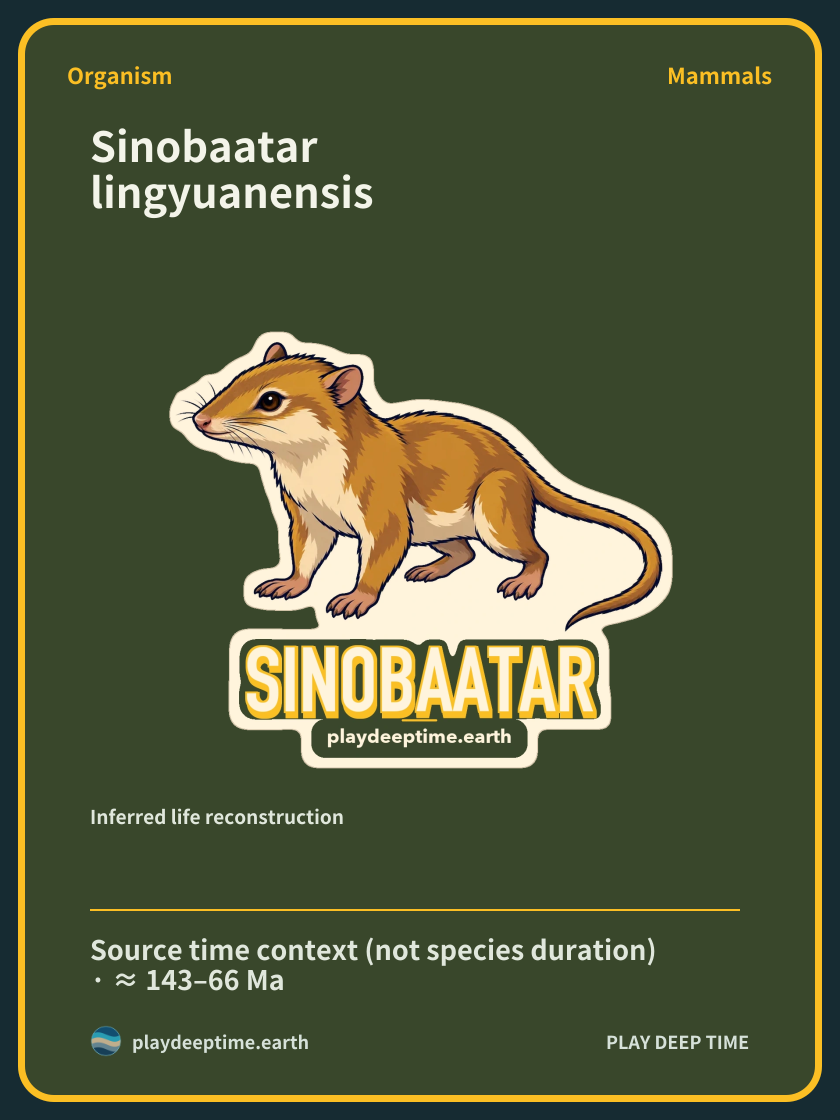
Inferred life reconstruction
Sinobaatar lingyuanensis
Overview
Sinobaatar lingyuanensis is a mammal known from the Early Cretaceous Yixian Formation. The connections among its narrow skull, jaws, trunk, and limbs are studied. Examining even the small bones of the wrist and foot allows comparisons of ancient mammal bodies.[1]
Loading illustration…
Key facts
The head, lower jaw, and neck vertebrae are described in the type specimen V12517. Different regions can be examined in connection with the same specimen. Unlike fossils studied only from the head, this material broadens questions to several parts of the body.[1]
Time and place
It is an Early Cretaceous mammal from the Yixian Formation in present-day Liaoning, China. The Early Cretaceous was roughly 140–100 million years ago. It has been studied as comparative material for mammals of the Jehol Biota.[1][2]
The time range describes source context, not the complete duration of this species.
Size, form and skeleton
The narrow skull and lower jaw and the skeleton extending from the neck and trunk to the limbs are described. Wrist bones and the fifth metatarsal also appear in the research. Small connections convey information different from the overall body outline.[1]
The small size of Sinobaatar lingyuanensis is apparent even in its lower jaw. A left lower jaw recorded in a 2009 comparative study is 17.8mm long, less than 2cm. Researchers compared the forms of such tiny jaws and teeth side by side to distinguish related species.[5]
Loading illustration…
Habitat and reproduction
Looking at limbs does not mean examining only the long bones. Research on Sinobaatar also includes the small bones of the wrist and metatarsus. It draws attention to the several parts connected within structures that support the body.[1]
Fossil discovery
The 2002 description introduced Sinobaatar as a new multituberculate from the Jehol Biota. It described the type specimen’s head in connection with its body skeleton. This added new anatomical clues for comparing mammals in the same biota.[1]
References
- 2002 study — Sinobaatar and the Jehol Biota
- International Commission on Stratigraphy (2024) — Geological time chart
- 2002 study — Sinobaatar and the Jehol Biota
- Hu et al. (2005) — A study of large Mesozoic mammals
- Kusuhashi et al. (2009) — Comparison of jaws and teeth of Cretaceous multituberculates from China
Research questions
Does a small wrist bone provide the same information as an externally visible toe? The interlocking bones inside and the outline visible outside are examined separately. Detailed fossil anatomy leads to questions about understanding the whole body.[1]
Observation
Move your gaze from the narrow head along the neck and trunk to the forelimbs and hind limbs. Examining where the wrists and feet connect reveals the construction of this small mammal.[1]
Related organisms
 Repenomamus giganticusMammalsSource time context (not species duration) · ≈ 143–66 Ma
Different mammals of the Yixian Formation
Sinobaatar and Repenomamus are mammals known from Early Cretaceous material in the Yixian Formation. Compare their different bodies and specimens to explore the varied forms of mammals in the age of dinosaurs.