Organism · Dinosaurs
Spinosaurus aegyptiacus
Source time context (not species duration) · ≈ 143–66 Ma
Inferred life reconstruction
Spinosaurus aegyptiacus
Overview
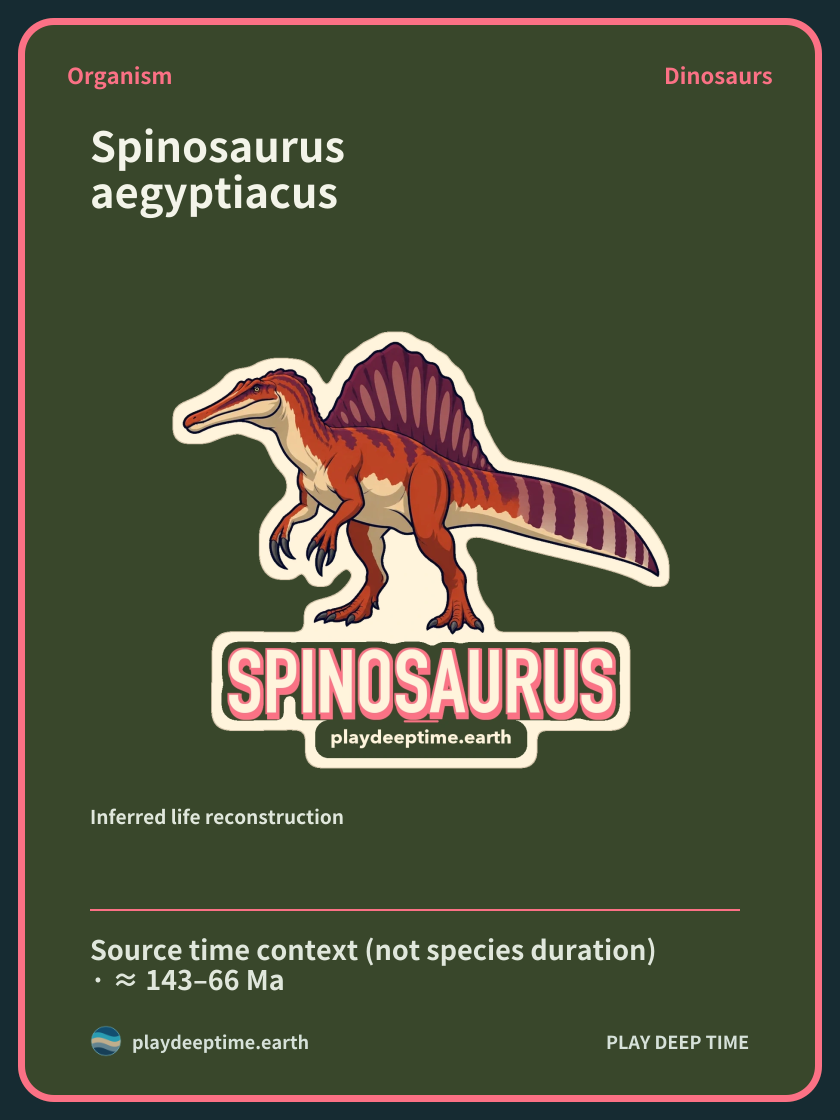
Spinosaurus aegyptiacus is a large carnivorous dinosaur distinguished by an elongated snout and a tall back sail. Its conical teeth, suited to catching fish, and its waterside life attract attention. Research into its bones and tail raises new questions about ancient dinosaur behavior.[3][5]
Loading illustration…
Key facts
Long vertebral spines lie inside the back sail. Fossil material assigned to a deep tail was also studied in 2020. Examining the rear body and back together reveals an outline different from other large carnivorous dinosaurs.[1][2]
Time and place
The type specimen came from the Bahariya Formation at Bahariya Oasis in present-day western Egypt. A 2006 study described this formation as early Cenomanian, in the Late Cretaceous, around 97 million years ago. A region that is now desert became an important fossil locality for studying ancient dinosaurs.[1]
The time range describes source context, not the complete duration of this species.
Size, form and skeleton
Features include a slender, elongated snout and smooth conical teeth. Tall neural spines on the back are associated with a large sail-shaped outline. A deep rear tail form has also been studied through a separate specimen.[3][1][2]
Loading illustration…
Habitat and reproduction
Aquatic life in Spinosaurus has prompted differing interpretations. A 2020 study compared physical models of tail shapes and reported that a Spinosaurus-shaped tail produced greater thrust and efficiency underwater than terrestrial dinosaur tail shapes. In 2021, Hone and Holtz reassessed its ecology and argued that a shoreline or shallow-water feeding model was better supported than a specialized underwater pursuit-predator model.[3][4][5][2][7]
Fossil discovery
Fossil collector Richard Markgraf discovered the partial type skeleton in autumn 1912. The fossil was destroyed in the 1944 bombing of Munich, but two earlier photographs survived.[1][2]
Researchers rediscovered photographs donated by Wolfgang Stromer in 1995 in an archive in 2000 and used them in a 2006 study. Surviving records can allow even lost fossils to be studied again. The 2020 deep-tail study examined a separately assigned specimen.[1][2]
References
- Smith et al. (2006) — New information on the Spinosaurus type specimen
- Ibrahim et al. (2020) — Theropod dinosaur tails and models of underwater propulsion
- Spinosaurus aegyptiacus — NHM genus guide
- Fabbri et al. (2022) — A study of bone compactness and underwater feeding
- Myhrvold et al. (2024) — Reanalysis of dinosaur aquatic lifestyles and bone-density data
- American Museum of Natural History — The story of Tyrannosaurus
- Hone·Holtz(2021). Evaluating the ecology of Spinosaurus: Shoreline generalist or aquatic pursuit specialist? Palaeontologia Electronica24(1):a03.
- Natural History Museum, London — How Baryonyx changed our understanding of spinosaurs
- Natural History Museum — Spinosaurus
Research questions
How active was Spinosaurus underwater? A 2022 bone-density study and a 2024 reanalysis offered different interpretations of the data, classification methods, and models. They show science refining a picture of life by examining fossil evidence with different methods.[4][5]
Observation
Move your gaze from the elongated snout to the tall back sail. Follow the outline to the tail to explore why several body regions have attracted attention in research into waterside life.[3][1][2]
Related organisms
 Tyrannosaurus rexDinosaursSource time context (not species duration) · ≈ 68–66 Ma
Heads and teeth of large carnivorous dinosaurs
Compare the massive, thick skull of Tyrannosaurus with the long, slender snout of Spinosaurus. They illustrate different feeding adaptations among large theropods.
 Baryonyx walkeriDinosaursSource time context (not species duration) · ≈ 143–66 Ma
Comparing spinosaurid relatives
Baryonyx and Spinosaurus belong to the same family, Spinosauridae. Compare the features of related dinosaurs through fossils known from different regions and times.