Organism · Seed plants
Taeniopteris spatulata
Fossil record age bounds · ≈ 260–143 Ma
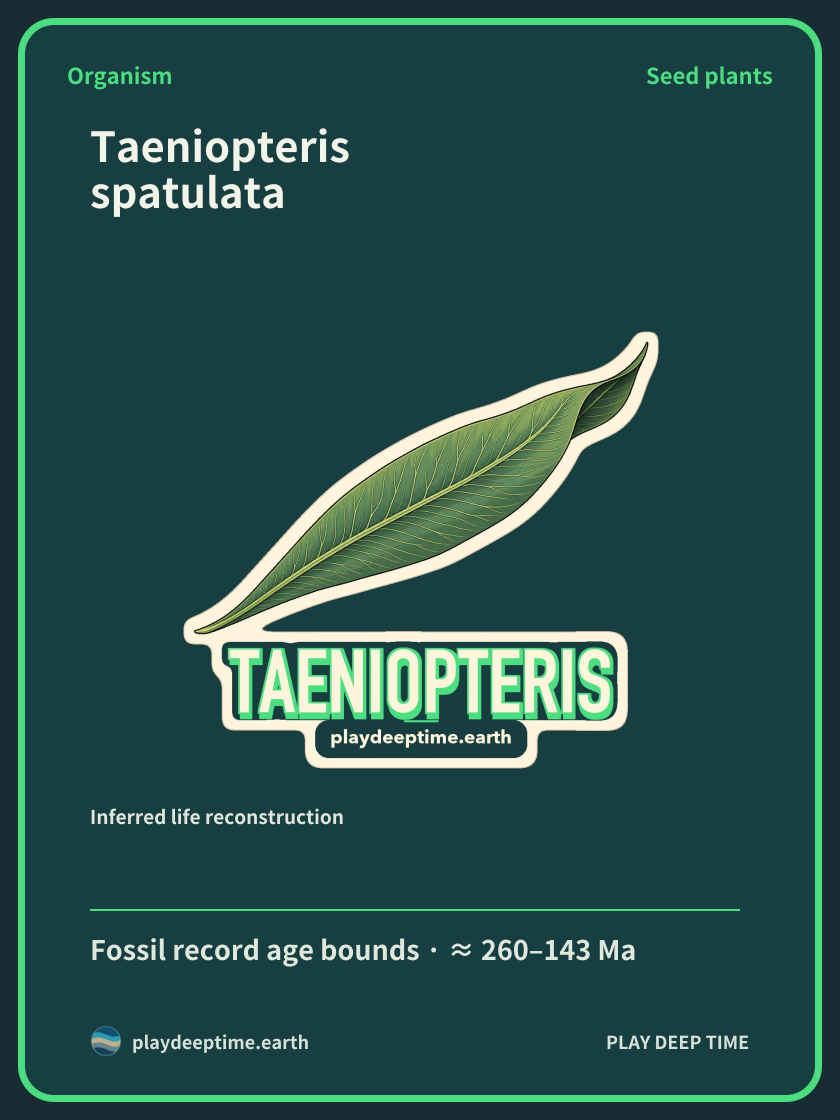
Inferred life reconstruction
Taeniopteris spatulata
Overview
Taeniopteris spatulata is a name encountered through fossil leaves. A 2014 paper describes narrow, spatula-like leaves with smooth margins and a distinct midvein.[1]
Loading illustration…
Key facts
Even leaf fragments can be compared with one another. The paper compared the venation of spatulata specimens with leaves previously reported from the Rajmahal Formation. Veins provide clues for reading detached fossils together.[1]
Time and place
This name also appears in research on Jurassic plants from the Catlins coast of present-day New Zealand. A 2020 paper on Middle–Late Jurassic fossil floras used the name spatulata for Taeniopteris leaves common in the region.[2]
The time range describes source context, not the complete duration of this species.
Size, form and skeleton
The specimen descriptions in the 2014 paper include simple leaves with a distinct midvein. Specimen numbers BSIP 40222 and 40224 are also recorded. Reading leaf outline, pattern, and specimen number together allows the same material to be located and compared.[1]
Taeniopteris spatulata is known for strap-shaped leaves with a stout central vein. Studied specimens from New Zealand’s Catlins coast vary from narrow leaves about 5 mm wide to broad leaves at least 27 mm wide.[4]
Loading illustration…
Habitat and reproduction
Field research on the ancient plants of the Catlins has continued since the late 1970s. The author investigated several coastal fossil localities and recorded each sample’s position. This is the research setting for reading a leaf together with its surrounding strata.[2]
Fossil discovery
Fossil-plant research accumulates small discoveries recorded by specimen number. The figure captions in the 2014 paper labeled two spatulata leaves with different BSIP numbers. Recording distinct fragments separately becomes the starting point for subsequent comparisons.[1]
References
- Geophytology (2014) — Description of leaf specimens of Taeniopteris spatulata
- Pole (2020) — Jurassic fossil plant assemblage of the Catlins coast, New Zealand
- van Konijnenburg-van Cittert et al. (2017) — Distinguishing Taeniopteris-type leaves
- Pole (2020) — Jurassic flora of the Catlins coast, New Zealand
- Fossil ginkgo leaves from Siberia
- Study of leaves and cuticles of Cenozoic ginkgoaleans from the Mediterranean
- Falkland fossil flora — Ginkgo-like leaves
Research questions
Do similar-looking leaves belong to the same plant group? A 2017 study explains that a preserved cuticle—the protective surface layer of a leaf—or reproductive organs can allow more specific distinctions. Leaves like these, lacking such clues, are placed in Taeniopteris, a grouping based on form.[3]
Observation
First follow the midvein to establish the leaf’s orientation. Then broaden your view to its margins and venation. Even a fragmentary leaf reveals different comparative features depending on the part examined.[1]
Related organisms
 Ginkgo adiantoidesSeed plantsSource time context (not species duration) · ≈ 56–23 Ma
Different bodies among plants
Explore the forms of Taeniopteris spatulata and ginkgo-like leaves together. Taeniopteris spatulata: Taeniopteris spatulata is a name encountered through fossil leaves. Ginkgo-like leaves: Ginkgo adiantoides is a ginkgo relative known from fan-shaped fossil leaves.