Organism · Mammals
Volaticotherium antiquum
Source time context (not species duration) · ≈ 252–66 Ma
Inferred life reconstruction
Volaticotherium antiquum
Overview
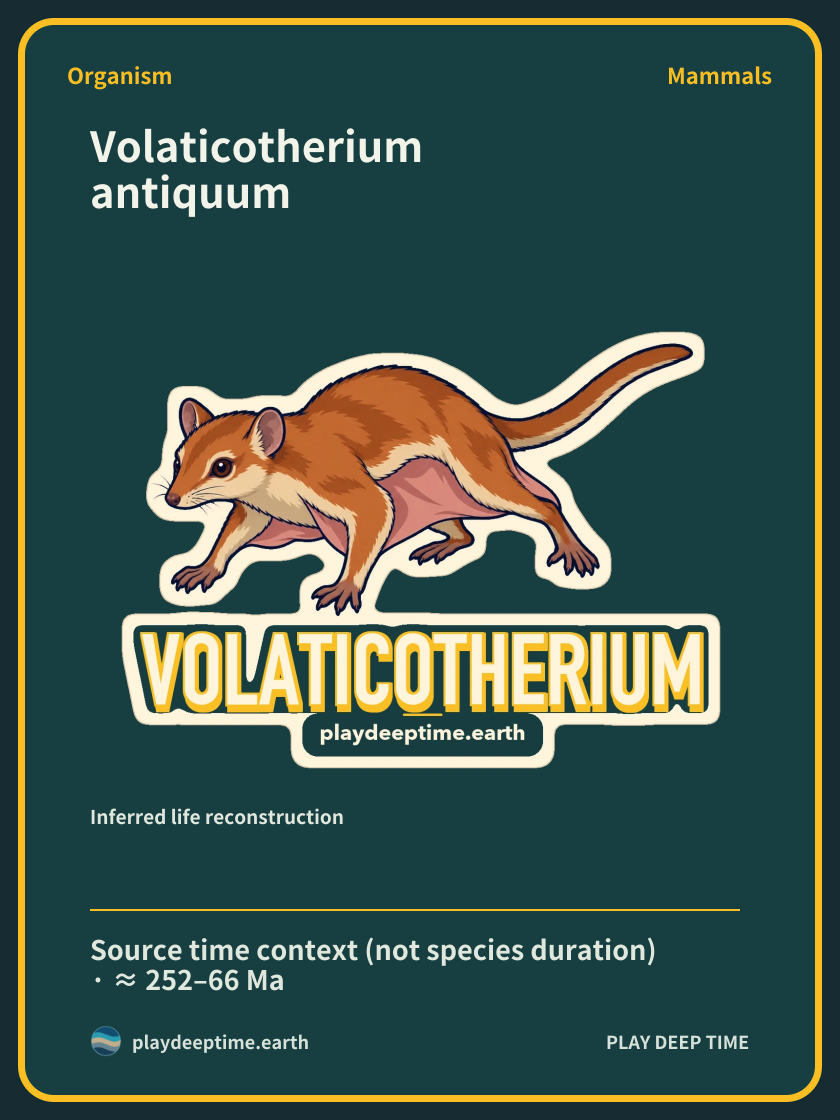
Not all mammals of the dinosaur age moved only along the ground. Volaticotherium antiquum was a small mammal known for long limbs and a fur-covered skin membrane. Its fossil prompted research into a life moving through the air in forests.[1]
Loading illustration…
Key facts
The fossil preserves traces of fur and a broad skin membrane as well as bones. Researchers interpreted this membrane as a gliding structure. Unlike flapping flight, this involves spreading a membrane around the body to travel through the air.[1]
Time and place
Its setting was Mesozoic Asia, when dinosaurs lived. The specimen locality is known as Daohugou in Ningcheng, present-day Inner Mongolia, China. Modern administrative place names help locate the ancient layers preserving this small mammal.[1]
The time range describes source context, not the complete duration of this species.
Size, form and skeleton
Elongated limbs, a long tail, and a fur-covered skin membrane form a striking combination. Hard bones and traces of soft body tissues survive together, helping reveal its covering and outline.[1]
In 2006, researchers estimated a combined head-and-body length of about 12–14 cm from the type specimen’s jaw length. This differs from total length including the long tail.[2]
The same study estimated a body mass of about 70 g based on the type specimen.[2]
Loading illustration…
Habitat and reproduction
Researchers linked the broad membrane surrounding the body and the limb forms to gliding in forests. It shows that mammals living alongside dinosaurs led varied lives using trees and aerial space as well as the ground.[1]
Fossil discovery
It was introduced in Nature in 2006 as a new Mesozoic mammal. Specimen IVPP V14739 preserves a compressed skeleton alongside traces of fur and membrane. Preservation of this small animal’s soft body makes the discovery special.[1]
References
Research questions
Reading a living three-dimensional body from a fossil with flattened bones and a thin membrane is difficult. Better understanding of membrane connections and limb movement enables finer comparisons of aerial life among Mesozoic mammals.[1]
Observation
Examine the long limbs, tail, and membrane around the body in sequence.[1]
Related organisms
 Castorocauda lutrasimilisMammaliaformsSource time context (not species duration) · ≈ 201–143 Ma
Gliding in forests and living beside water
Explore the different living spaces used by Mesozoic mammals and their relatives. Volaticotherium antiquum: researchers linked its broad body membrane and limb shapes to forest gliding, showing that mammals alongside dinosaurs used trees and aerial space as well as the ground. Castorocauda: how did it live near water? Researchers proposed webbing from soft-tissue traces around the hind feet and interpreted robust forelimbs and hands as digging adaptations. They inferred its life from preserved tissues and bone form together.