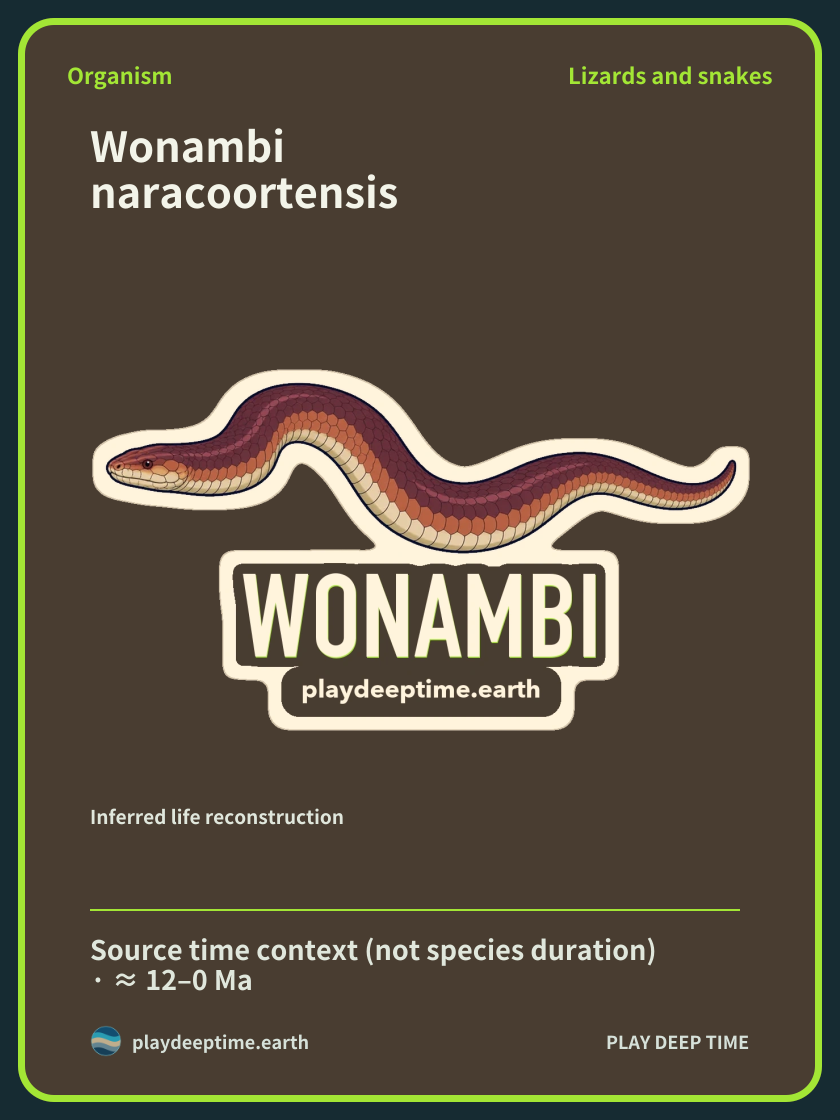
Organism · Lizards and snakes
Wonambi naracoortensis
Source time context (not species duration) · ≈ 12–0 Ma
Inferred life reconstruction
Wonambi naracoortensis
Overview
Wonambi naracoortensis is a fossil snake known from skull elements, vertebrae, ribs, and partial skeletons. Several specimens convey different information about its body. Many bones help reveal its elongated form.[1][2]
Loading illustration…
Key facts
Later studies examined skull material as well as vertebrae and ribs. Repeated structures in the long trunk and small skull bones provide different comparative clues.[1][3]
Time and place
Material from Australian fossil localities has been studied. A 2000 study treats Wonambi as a Pleistocene snake. The Pleistocene spans approximately 2.6 million to 12,000 years ago.[3][4]
The time range describes source context, not the complete duration of this species.
Size, form and skeleton
Species-specific material includes skull elements, the lower jaw, vertebrae, and ribs. Partial skeletons such as SAM P30178 and HJD1 are separately known. Several specimens allow comparison of the organization of the head and elongated body.[1][2]
A 1997 account by the Australian Museum described two partial Wonambi skeletons from Henschke Cave and gave a body length of about 6 m. This size is based on partial skeletons.[5]
Loading illustration…
Habitat and reproduction
What connections among bones reveal the body of a long snake? Repeated vertebrae and ribs can be examined alongside separate skull material. This research reads a large outline by dividing it into many small structures.[1][2]
Fossil discovery
A 1996 description examined partial Wonambi skeletons and ribs. In 2000, skull material was used to address questions about early snake evolution, and a 2005 description also discussed this evidence. Repetition along the body and skull features lead to different questions.[1][2][3]
References
- 2005 study — Descriptive material from the Wonambi study
- Scanlon (1996) — A partial skeleton of Wonambi
- 2000 study — Pleistocene Wonambi and early snake evolution
- International Commission on Stratigraphy (2024) — Geological time chart
- Australian Museum (1997) — Wonambi and the giant snakes of Gondwana
- Scanlon (1992) — A new large snake from the Miocene of northern Australia
Research questions
What information do the skull and vertebrae provide about snake relationships? Comparing different body regions allows combinations of features to be examined. As later material became known, more regions became available for comparison.[1][3]
Observation
Move your gaze from the head to the trunk, where vertebrae and ribs repeat. Considering the regions known from each partial skeleton helps reveal the organization of the elongated body.[1][2]
Related organisms
 Yurlunggur camfieldensisLizards and snakesFossil record age bounds · ≈ 16–11.6 Ma
Different bodies among snakes
Compare the bodies and backgrounds of Wonambi and Yurlunggur camfieldensis. Wonambi: Wonambi naracoortensis is a fossil snake known from skull elements, vertebrae, ribs, and partial skeletons; several specimens convey different information about its body. Yurlunggur camfieldensis: a large snake known from fossils in northern Australia, whose elongated body story begins with vertebrae.