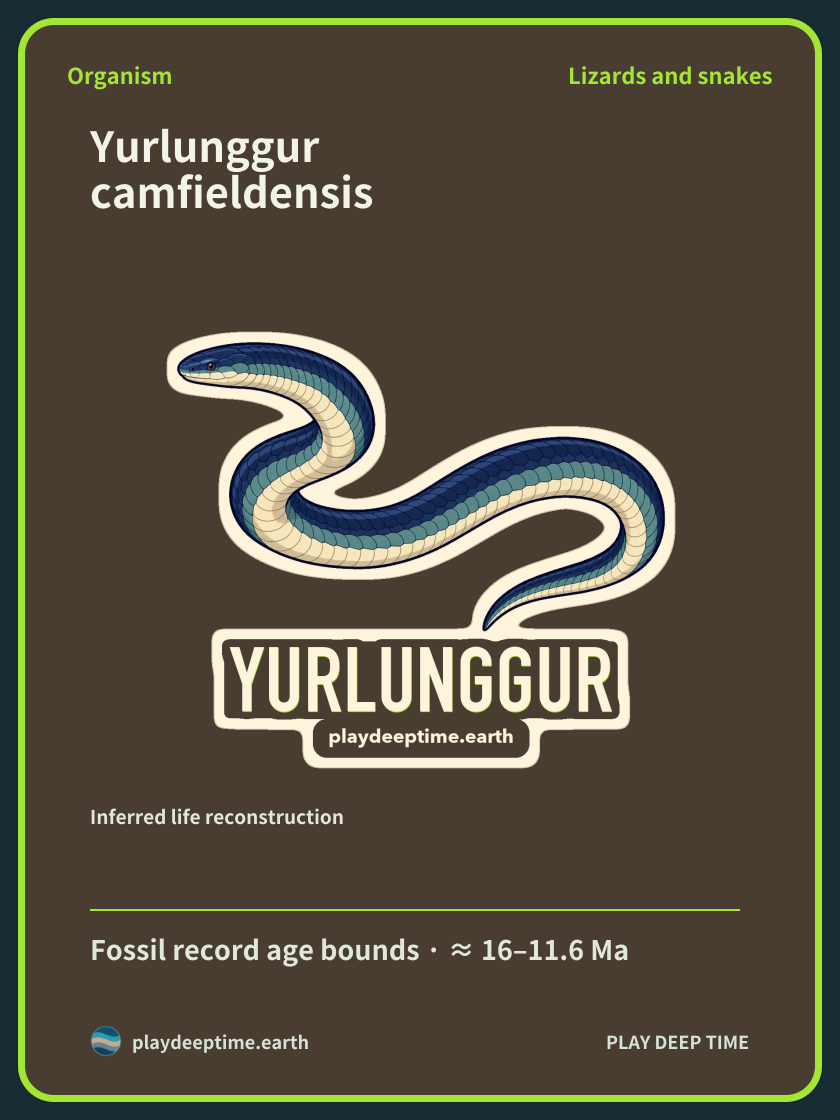
Organism · Lizards and snakes
Yurlunggur camfieldensis
Fossil record age bounds · ≈ 16–11.6 Ma
Inferred life reconstruction
Yurlunggur camfieldensis
Overview
Yurlunggur camfieldensis was a large snake known from fossils in northern Australia. The story of its elongated body begins with vertebrae. Its describer interpreted several vertebrae from one locality as belonging to a single individual when naming the snake.[1]
Loading illustration…
Key facts
Even a snake’s neck has a special bone: the axis, the second neck vertebra behind the skull. A 2004 study introduced the Yurlunggur axis as the first known for the extinct family Madtsoiidae. One small bone provided a new starting point for comparing snake necks.[2]
Time and place
Specimens of this snake came from the middle Miocene Camfield Formation at Bullock Creek in the present-day Northern Territory of Australia. Following the formation and locality reveals records of ancient snakes in northern Australia.[1]
The time range describes source context, not the complete duration of this species.
Size, form and skeleton
Vertebrae and ribs provide important clues to this species. In 2004, the researcher explained that bones from the Blast Site were consistent with belonging to a single skeleton. Comparing trunk vertebrae with anterior neck vertebrae allows different regions of the elongated body to be read.[2]
Yurlunggur camfieldensis is estimated to have been about 6.5 m long. This is the reconstructed length reported in a 2004 study.[4]
Loading illustration…
Habitat and reproduction
The Camfield Formation at Bullock Creek also contains traces of ancient rivers. Geological research describes freshwater carbonate sediments deposited by branching and meandering rivers. Oxbow lakes sometimes formed after channels were abandoned. Consider the layers preserving the snake’s fossils within a landscape of rivers and lakes.[3]
Fossil discovery
The 1992 description of the new species interpreted 18 vertebrae from the same locality as belonging to one individual. In 2004, the axis was studied in detail and associated with the species’ type skeleton. The discovery did not end with naming: reexamining one part of the skeleton continued its story.[1][2]
References
- Scanlon (1992) — A new large snake from the Miocene of northern Australia
- Scanlon (2004) — The axis vertebra of Yurlunggur camfieldensis and the snake neck
- Schwartz (2016) — Fauna and geological setting of Bullock Creek
- Scanlon (2004) — Neck vertebrae and total body length of Yurlunggur
- 2005 study — Descriptive material from the Wonambi study
- Scanlon (1996) — A partial skeleton of Wonambi
Research questions
If Yurlunggur bones are found in other regions, do they all belong to the same species? The 2004 study distinguished material from Riversleigh and other localities as unidentified at species level or belonging to different species. Even a shared genus name calls for renewed comparison of vertebral features and localities.[2]
Observation
First follow the outline from the head through the neck and trunk to the tail. In the fossil material, compare the axis near the front of the neck with trunk vertebrae. Different clues emerge when the elongated body is viewed as one line and when it is divided bone by bone.[2]
Related organisms
 Wonambi naracoortensisLizards and snakesSource time context (not species duration) · ≈ 12–0 Ma
Different bodies among snakes
Compare the bodies and backgrounds of Yurlunggur camfieldensis and Wonambi. Yurlunggur camfieldensis: a large snake known from fossils in northern Australia, whose elongated body story begins with vertebrae. Wonambi: Wonambi naracoortensis is a fossil snake known from skull elements, vertebrae, ribs, and partial skeletons. Several specimens convey different information about its body.