Organism · Ray-finned fishes
Xiphactinus audax
Source time context (not species duration) · ≈ 143–66 Ma
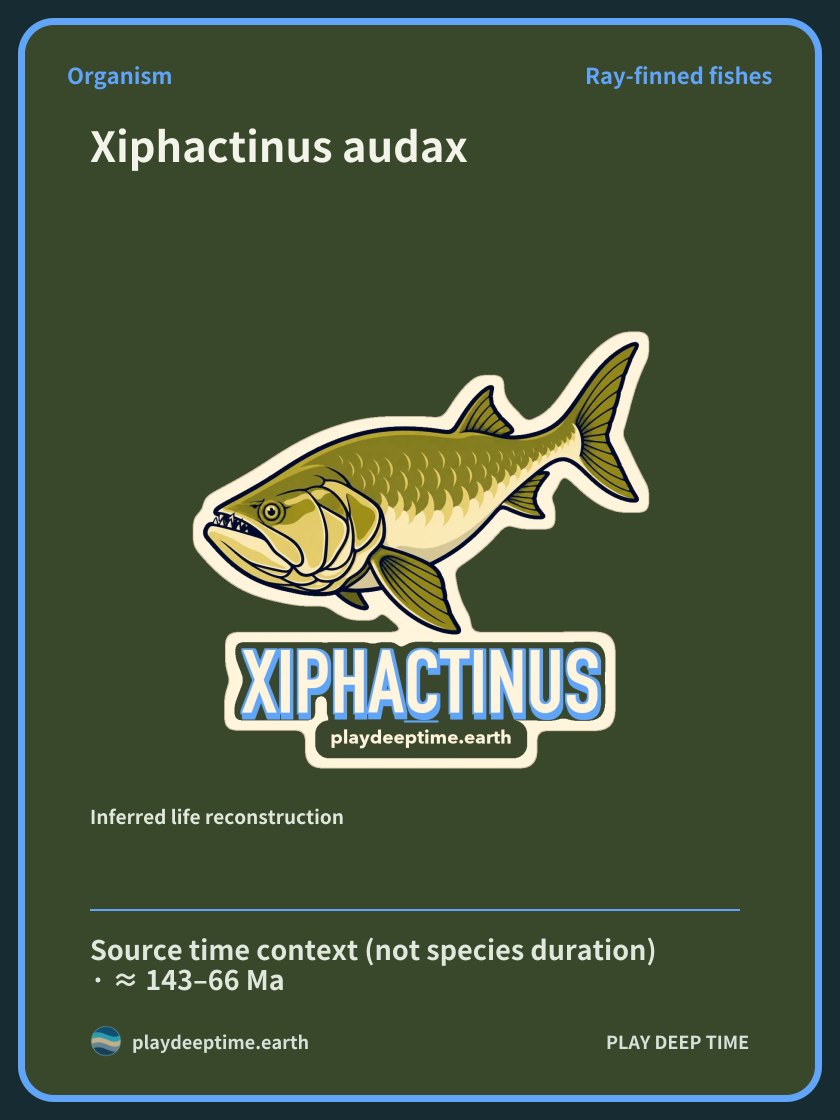
Inferred life reconstruction
Xiphactinus audax
Overview
Xiphactinus audax is a predatory fish of the Cretaceous seas with large jaws. A thick front portion of the trunk continues into a body and tail that taper rearward. It is also well known from fossils preserving another fish inside its body.[1][3][4]
Loading illustration…
Key facts
The 'fish within a fish' specimen in museum records contains a Gillicus. The literature also presents large Xiphactinus specimens exceeding 5 m in length. The large jaws and food inside the body convey different clues.[4][5]
Time and place
It is known as a fish of the Late Cretaceous seas. The skeleton discussed by Everhart is described as coming from Early Santonian beds in the Smoky Hill Chalk of present-day Kansas, USA. The Cretaceous as a whole spans roughly 140–66 million years ago.[1][3][2]
The time range describes source context, not the complete duration of this species.
Size, form and skeleton
A thick anterior trunk follows the large, deep head and jaws, and the body tapers toward the rear. Major features include pectoral fins near the shoulder, fins farther back, a narrow tail stalk, and a forked tail.[1]
Loading illustration…
Habitat and reproduction
What traces might a large-mouthed predator leave? Specimens of Xiphactinus preserving another fish inside allow prey and predator to be examined together. The record containing Gillicus provides a kind of clue to life different from the body's outer form.[3][4]
Fossil discovery
Everhart explained that the skeleton he discovered in 1996 went on to be collected, prepared, and displayed. A separate museum record presents the 'fish within a fish' specimen containing Gillicus. The skeleton and traces of food offer different stories of discovery.[1][4]
References
- Mike Everhart — The skeleton and occurrence of Xiphactinus
- International Commission on Stratigraphy (2024) — Geological time chart
- Smithsonian Ocean guide — Xiphactinus
- Sternberg Museum record — Fish within a fish
- Evidence of endothermy in Xiphactinus audax · Ferrón2020
- Fukui Prefectural Dinosaur Museum — Tylosaurus proriger specimen
- Smithsonian Ocean — Xiphactinus
Research questions
What does food preserved inside the body reveal that skeletal form does not? Jaws and fins convey body structure, while a fish remaining in the stomach records a feeding event. There is much to discover by reading different kinds of fossil evidence together.[1][4]
Observation
Follow the large jaws through the thick anterior trunk to the narrow tail stalk. Examining the positions of the pectoral fins, rear fins, and forked tail reveals how the outline changes from front to back.[1]
Related organisms
 Tylosaurus prorigerLizards and snakesSource time context (not species duration) · ≈ 143–66 Ma
Large predators of the Cretaceous seas
Tylosaurus is a marine reptile, while Xiphactinus is a large fish. They allow comparisons of predators with different bodies in the Late Cretaceous seas.