Organism · Molluscs
Yochelcionella cyrano
Fossil record age bounds · ≈ 511–508 Ma
Inferred life reconstruction
Yochelcionella cyrano
Overview
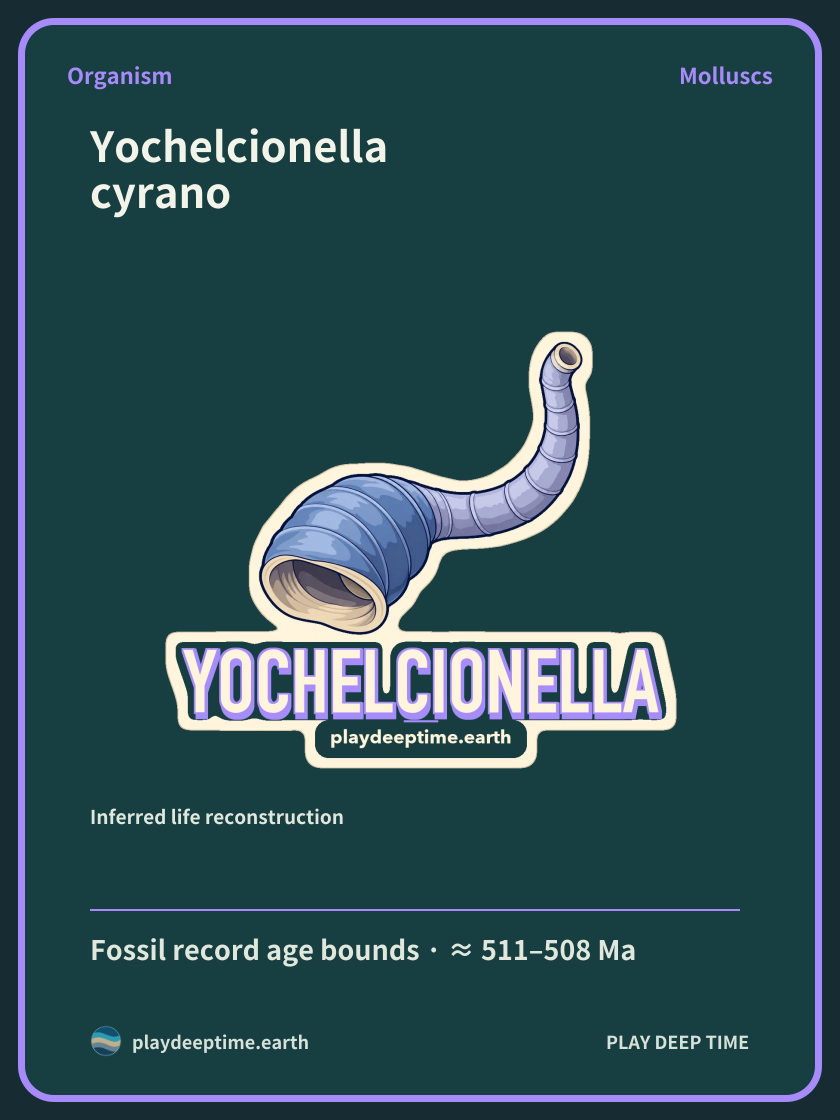
Yochelcionella cyrano was a Cambrian mollusk distinguished by a long tube projecting from its shell. Research calling this tube a “snorkel” revealed a new aspect of the tiny shell.[1]
Loading illustration…
Key facts
A new specimen showed that the tube was much longer than previously thought. The researcher interpreted its size as a clue that it served an important function throughout the animal’s life.[1]
Time and place
The studied specimens came from the Coonigan Formation near Broken Hill in present-day New South Wales, Australia. The 1980 paper presented the material as early Middle Cambrian, in the regional Ordian interval.[1]
The time range describes source context, not the complete duration of this species.
Size, form and skeleton
The nearly complete shell ANU30650 was described as about 5 mm high. Its attached long tube follows the same spiral curvature as the shell, inviting consideration of the relationship between the small shell and its projection.[1]
Loading illustration…
Habitat and reproduction
The author interpreted growth of the tube along the same curvature as the shell as maintaining the relative orientation of the two openings. This is a story of growth read from fossils by examining how relationships between structures persisted.[1]
Fossil discovery
Runnegar and Jell introduced new shell material in their 1980 study. ANU30650 is a nearly complete specimen with the tube attached, while separate specimen ANU30651 preserved ring-like growth lines on the tube.[1]
References
- Australian Middle Cambrian molluscs: corrections and additions
- Paleobiology Database — Fossil occurrence records for Campanile giganteum
- de Winter et al. (2020), “The Giant Marine Gastropod Campanile giganteum (Lamarck, 1804) as a High-Resolution Archive of Seasonality in the Eocene Greenhouse World.”
- VUB — Giant sea snail fossil reveals climate of French Champagne region
- National Museum of Natural History, Paris — Campanile giganteum
Research questions
New information obtained after the 1976 study led to a paper of corrections and additions in 1980. This illustrates how a single small new specimen can change the appearance of an already known organism.[1]
Observation
The illustration is based on the shell and attached tube of ANU30650. Follow the shell’s curve into the tube’s curve and examine the relative directions of the two openings.[1]
Related organisms
 Campanile giganteumMolluscsSource time context (not species duration) · ≈ 56–38 Ma
Different shells of the Cambrian and Eocene
Examine the different records of bodies and time preserved in these two organisms. Yochelcionella cyrano: a Cambrian mollusk with a long tube projecting from its shell; research calling the tube a “snorkel” revealed a new aspect of the tiny shell. The studied specimens came from the Coonigan Formation near Broken Hill in present-day New South Wales, Australia. The 1980 paper presented them as early Middle Cambrian, in the regional Ordian interval. Campanile giganteum: seasons of an ancient sea are hidden within a large, tower-like spiral shell. This gastropod lived in Eocene European seas. Fossils used in research date to the middle Eocene, about 45 million years ago, and came from Fleury-la-Rivière in the Champagne region of present-day France.